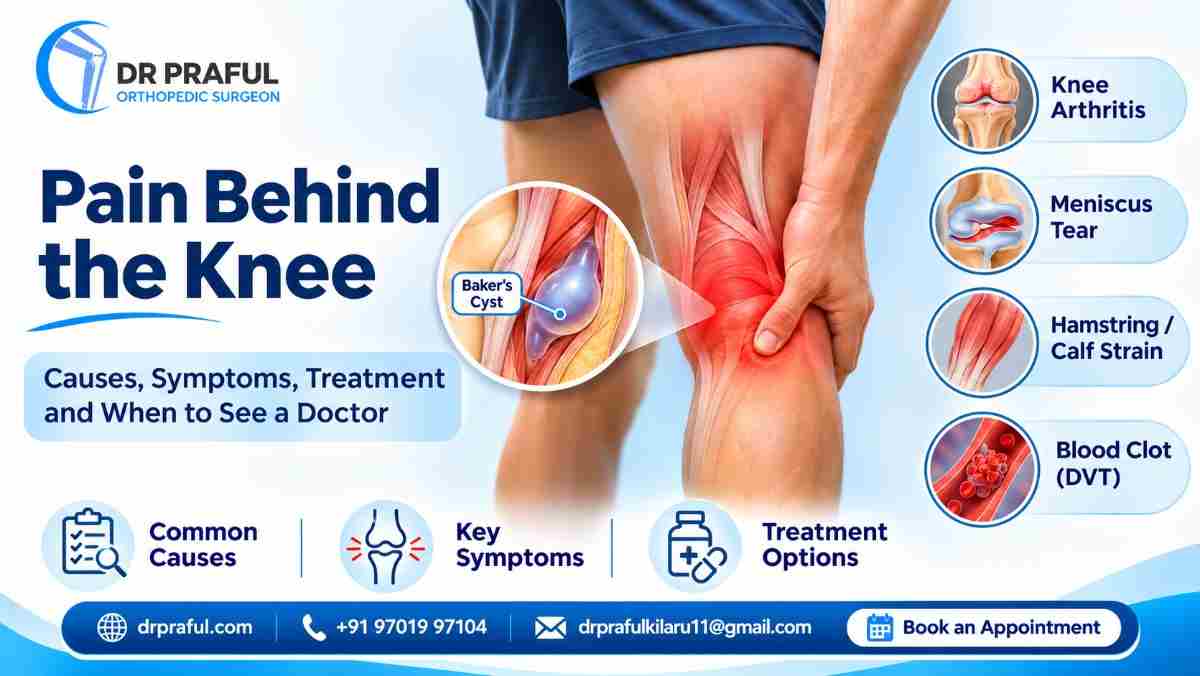
Pain behind the knee is most often caused by a Baker's cyst (a fluid-filled swelling at the back of the knee), a hamstring or calf muscle strain, a meniscus tear, or knee arthritis. Less commonly, back of knee pain can be a sign of a blood clot in the leg (deep vein thrombosis), which needs urgent medical care. Mild pain after exercise often settles with rest, ice and gentle stretching, but pain that lasts more than a few days, comes with swelling, or makes it hard to bend or straighten the knee should be checked by an orthopaedic doctor.
Reviewed by Dr. Praful Kilaru, Senior Consultant Joint Replacement & Complex Trauma Surgeon, Yashoda Hospitals, Malakpet, Hyderabad.
Seek urgent care if
Your calf is swollen, warm, red or tender along with pain behind the knee, or you suddenly feel short of breath or have chest pain. These can be signs of a blood clot (DVT) and need same-day medical attention.
Common Causes of Pain Behind the Knee at a Glance
Cause
Typical signs
Who gets it
Baker's cyst
Swelling or a soft lump at the back of the knee, tightness when bending or straightening
People with knee arthritis or a meniscus tear
Hamstring strain or tendinitis
Pain at the back of the thigh and knee, worse when bending the knee against resistance or running
Runners, footballers, people who sprint
Calf (gastrocnemius) strain
Pain in the upper calf just below the back of the knee, worse when standing on tiptoe
Sports players, middle-aged people starting new exercise
Meniscus tear
Pain at the back or side of the knee, swelling, catching or locking, pain when squatting
Twisting injuries in young people; wear-related tears after 40
Knee arthritis
Stiffness, aching all around the knee including the back, worse after walking
Mostly people over 50
PCL injury
Pain at the back of the knee after a fall on a bent knee or a dashboard injury
Road traffic accidents, contact sports
Popliteus tendinitis
Pain at the back and outer side of the knee, worse walking downhill
Runners and hikers
Deep vein thrombosis (DVT)
Calf swelling, warmth, redness and pain; can feel like a cramp
After surgery, long travel, bed rest, pregnancy
What Causes Back of Knee Pain? Explained Simply
1. Baker's cyst
A Baker's cyst (popliteal cyst) forms when extra joint fluid collects in a pouch at the back of the knee. It usually happens because of another knee problem, such as osteoarthritis or a meniscus tear, which makes the knee produce more fluid. You may feel a soft lump, tightness or fullness behind the knee, especially when the knee is fully bent or straight. Sometimes a cyst bursts, causing sudden calf pain and swelling that can look like a blood clot, so it should be checked by a doctor.
2. Hamstring strain or tendinitis
The hamstring muscles run down the back of the thigh and attach just below the knee. A sudden sprint or overstretching can strain them, while repeated running can irritate the tendons. Pain is felt at the back of the thigh or behind the knee and gets worse when you bend the knee against resistance.
3. Calf muscle strain
The gastrocnemius muscle starts just above the back of the knee. A strain causes pain in the upper calf and behind the knee, often after a sudden push-off, such as starting to run or jumping. Standing on tiptoe is usually painful.
4. Meniscus tear
The menisci are two C-shaped cartilage cushions inside the knee. A tear in the back part of the meniscus can cause pain behind the knee, swelling, and a catching or locking feeling. Young people often tear the meniscus with a twisting injury, while in people over 40 a tear can happen with minor movements because the cartilage weakens with age. Read more about meniscal tear treatment in Hyderabad and recovery time for a meniscus tear.
5. Knee arthritis
Osteoarthritis wears down the cartilage of the knee and can cause aching all around the joint, including the back. It also commonly leads to a Baker's cyst. Stiffness after rest and pain after walking are typical. See our guide to early symptoms of arthritis in the knee and knee arthritis grades.
6. Posterior cruciate ligament (PCL) injury
The PCL is a strong ligament at the back of the knee. It is usually injured by a fall onto a bent knee or when the shin hits the dashboard in a car accident. Pain behind the knee, swelling and a feeling of the knee being unstable are common. Learn more about PCL reconstruction surgery in Hyderabad.
7. Popliteus tendinitis
The popliteus is a small muscle at the back of the knee. Overuse, especially running downhill, can irritate its tendon and cause pain at the back and outer side of the knee.
8. Deep vein thrombosis (DVT)
A blood clot in the deep veins of the leg can cause pain behind the knee or in the calf, along with swelling, warmth and redness. The risk is higher after surgery, a long flight or bus journey, long bed rest, pregnancy or with some medicines. DVT needs urgent treatment because a clot can travel to the lungs.
Pain Behind Knee When Bending
Pain at the back of the knee when you bend it, squat or sit cross-legged is usually caused by:
- Baker's cyst: the swelling gets squeezed when the knee bends, causing tightness
- Meniscus tear: the torn part gets pinched during deep bending or squatting
- Hamstring tendinitis: bending the knee against resistance stresses the tendons
- Knee arthritis: worn cartilage and joint swelling limit how far the knee bends
Pain behind the knee when straightening it or standing up from a chair is more often linked to a Baker's cyst, calf strain or arthritis. If bending is painful along with clicking, locking or the knee giving way, a meniscus or ligament injury is more likely and needs an examination.
When Is Pain Behind the Knee Serious?
See a doctor promptly if you have:
- Calf swelling, warmth or redness, or pain that feels like a cramp that will not go away
- Sudden severe pain or swelling after an injury, or a "pop" at the time of injury
- A knee that locks, gets stuck or gives way
- Inability to put weight on the leg
- Fever with a hot, swollen knee
- Pain that is not improving after one to two weeks of rest and home care
You can also read when to see an orthopedic doctor for joint pain.
How Doctors Find the Cause
Test
What it shows
Physical examination
Where the pain is, swelling, movement, ligament stability and signs of a meniscus tear
Ultrasound
Baker's cyst, fluid in the knee and tendon problems
Doppler ultrasound
Blood clots in the leg veins (DVT)
X-ray
Arthritis, bone spurs and fractures
MRI
Meniscus tears, ligament injuries (such as the PCL) and cartilage damage
Treatment for Back of Knee Pain
Treatment depends on the cause. Most cases improve without surgery.
Home care for mild pain
- Rest from activities that cause pain, such as running, squatting or climbing stairs
- Ice wrapped in a cloth for 15–20 minutes, two to three times a day, for the first few days
- Compression with an elastic knee support to control swelling
- Elevation of the leg on a pillow when resting
- Pain relief medicines or gels, as advised by your doctor or pharmacist
Medical treatment
- Physiotherapy to stretch tight hamstring and calf muscles and strengthen the thigh and hip muscles
- Treating the underlying problem: a Baker's cyst often settles when the arthritis or meniscus tear causing it is treated
- Aspiration or injection of a large, painful cyst or swollen knee in selected cases
- Blood-thinning medicines if a DVT is found
- Arthroscopic (keyhole) surgery for some meniscus tears that cause locking or do not improve with physiotherapy; read meniscus tear surgery vs physiotherapy
- Ligament reconstruction for some severe PCL injuries
- Knee replacement only for advanced arthritis when other treatments no longer help
Do not massage a painful swollen calf
If your calf is swollen, warm and tender, avoid massaging it until a blood clot has been ruled out. Massage could dislodge a clot.
Gentle Exercises for Pain Behind the Knee
Once severe pain and swelling have settled, and a blood clot has been ruled out, these gentle exercises can help. Stop if any exercise causes sharp pain.
Exercise
How to do it
Hamstring stretch
Sit with the leg straight in front, keep your back straight and lean forward gently until you feel a stretch at the back of the thigh; hold 20–30 seconds
Calf stretch
Stand facing a wall, step the painful leg back with the heel on the floor and the knee straight, lean forward until you feel a stretch in the calf; hold 20–30 seconds
Heel slides
Lie on your back and slowly slide the heel towards your buttock, then straighten; repeat 10 times
Quad sets
Lie with the leg straight and tighten the thigh muscle by pressing the back of the knee down; hold 5 seconds, repeat 10 times
Hamstring curls (standing)
Hold a chair and slowly bend the knee to lift the heel towards the buttock; repeat 10 times
For more ideas, see our best exercises for knee pain.
How to Prevent Back of Knee Pain
- Warm up and stretch the hamstrings and calves before sports or running
- Increase running distance or exercise intensity gradually
- Keep a healthy weight to reduce load on the knees
- Strengthen the thigh, hip and calf muscles
- Wear supportive footwear
- On long journeys, walk around every hour or two and move your ankles to keep blood flowing
For other knee problems, read swollen knee causes and treatment and what causes sudden knee pain without injury.
Knee Pain Care with Dr. Praful Kilaru in Hyderabad
Dr. Praful Kilaru is a Senior Consultant Joint Replacement and Complex Trauma Surgeon at Yashoda Hospitals, Malakpet, Hyderabad, with 18 years of orthopaedic experience. He evaluates knee pain, sports injuries, meniscus and ligament tears and arthritis. Learn more about knee pain treatment in Hyderabad, visit his orthopaedic practice in Hyderabad or book a consultation.
Frequently Asked Questions: Pain Behind the Knee
What is the most common cause of pain behind the knee?
The most common causes are a Baker's cyst, a hamstring or calf muscle strain, a meniscus tear and knee arthritis. In older adults, a Baker's cyst linked to arthritis is very common, while in young active people, muscle strains and meniscus tears are more likely.
Can pain behind the knee be serious?
Usually it is not serious, but it can be a sign of a blood clot (DVT), especially if the calf is swollen, warm, red or tender. In that case, seek medical care the same day.
Why does the back of my knee hurt when I bend it?
Pain when bending is often caused by a Baker's cyst being squeezed, a meniscus tear getting pinched, hamstring tendinitis or arthritis. Clicking, locking or the knee giving way suggest a meniscus or ligament problem.
How do I know if I have a Baker's cyst?
A Baker's cyst usually feels like a soft swelling or tightness at the back of the knee, more noticeable when standing with the leg straight. An ultrasound can confirm it and also rule out a blood clot.
How long does pain behind the knee take to heal?
A mild muscle strain often improves in one to three weeks with rest and stretching. A Baker's cyst or meniscus tear may take longer and depends on treating the underlying problem.
Should I walk with pain behind my knee?
Gentle walking is usually fine for mild pain, but avoid running, squatting and climbing many stairs until it settles. If you cannot put weight on the leg or the calf is swollen, see a doctor first.
Is ice or heat better for back of knee pain?
Ice is usually better in the first few days after an injury or when there is swelling. Gentle heat can help later for muscle tightness, once swelling has settled.
Can sitting for long cause pain behind the knee?
Sitting for long periods can make the hamstrings and calf feel tight and stiff, and very long journeys increase the risk of a blood clot. Stand up and walk around regularly.
When should I see a doctor for pain behind the knee?
See a doctor if the pain lasts more than one to two weeks, there is swelling, the knee locks or gives way, you cannot bear weight, or the calf is swollen, red or warm.
Which doctor should I see for pain behind the knee?
An orthopaedic doctor is the right specialist for most causes, such as Baker's cysts, meniscus tears, ligament injuries and arthritis. If a blood clot is suspected, go to the emergency department or your nearest doctor immediately.
Medical disclaimer: This article is for general information and does not replace a medical consultation. If you have calf swelling, redness or warmth, or sudden shortness of breath, seek urgent medical care.
References: NHS: Baker's cyst · NHS: Knee pain · AAOS OrthoInfo: Meniscus Tears · NHS: DVT · MedlinePlus: Baker cyst