You reach up to grab something from a high shelf, and there it is — a sharp, burning pain deep in your shoulder. Or maybe it wasn’t a sudden moment at all. It just crept up on you over weeks: difficulty sleeping on your side, weakness when lifting your arm, a dull ache that never fully goes away. If this sounds familiar, there is a good chance you are dealing with a torn rotator cuff. Here is the thing most patients don’t realize until they are already sitting in a surgeon’s office: a torn rotator cuff does not automatically mean you need surgery.
Thousands of people recover fully without ever going under the knife. But others wait too long, try to push through it, and end up with a tear that has grown from manageable to irreparable. The difference between those two outcomes almost always comes down to one thing getting the right information early and acting on it. This guide gives you exactly that. We will walk you through what a rotator cuff tear actually is, how to recognize the symptoms, what your real treatment options are, and how to make the decision that is right for your specific situation.
What Is a Torn Rotator Cuff And Why Does It Happen?
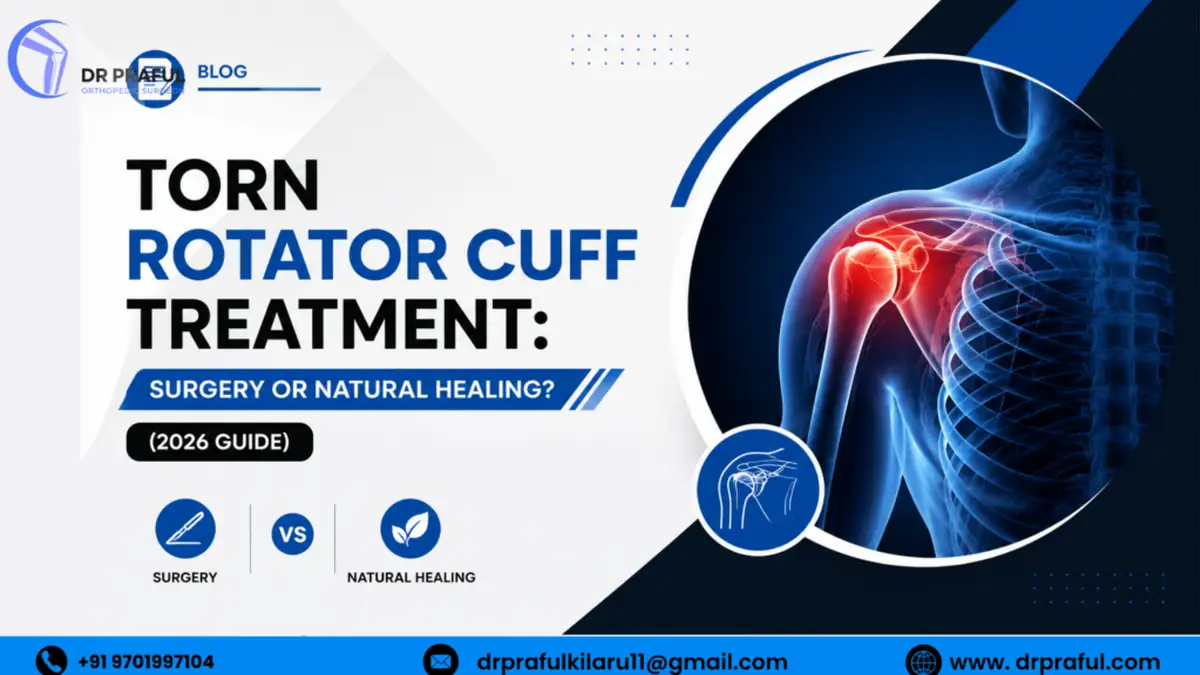
The rotator cuff is a group of four muscles and their tendons that wrap around the shoulder joint. Their job is to hold your upper arm bone (the humerus) firmly in place while allowing you to lift, rotate, and reach in every direction. They are the unsung workhorses of your shoulder.
When one or more of these tendons tears either partially or completely you have a rotator cuff tear. The most commonly injured tendon is the supraspinatus, which runs across the top of the shoulder.
Tears happen in two main ways
Acute tears happen suddenly from a fall, a heavy lift, or a direct blow to the shoulder. A classic example is someone falling on an outstretched arm or lifting something far too heavy at the gym. Degenerative tears develop gradually over years of wear and use. This type is far more common. Age, repetitive overhead activity (think painters, swimmers, tennis players, warehouse workers), and family history all increase your risk.
Rotator Cuff Tear Symptoms You Should Not Ignore
Symptoms vary depending on whether the tear is partial or full-thickness, and how long it has been there. But the most common warning signs include:
— Pain on the outside or front of the shoulder, especially when lifting your arm
— Weakness when reaching overhead or rotating the arm outward
— A crackling or popping sensation when moving the shoulder
— Pain that wakes you up at night, especially when lying on the affected side
— Difficulty with everyday tasks like brushing your hair, fastening a seat belt, or putting on a jacket
Practical example: Mark, a 52-year-old electrician, noticed he could no longer reach above his head without sharp pain after a day of overhead cable work. He put it off for three months, assuming it was muscle soreness. By the time he got an MRI, what had started as a partial tear had progressed to a full-thickness tear — and his treatment options had narrowed significantly.
Torn Rotator Cuff Treatment Your Real Options in 2026
Once you have a diagnosis, your treatment path depends on three key factors: the size of the tear (partial vs. full-thickness), your age and activity level, and how long you have had the injury.
Here is an honest breakdown of every treatment option available
For small to medium partial tears, non-surgical treatment is often the recommended starting point, and for many patients, it is the ending point too. Rest and activity modification: Avoiding the movements that aggravate the shoulder while the tendon calms down. This does not mean complete immobility — it means being smart about what you ask your shoulder to do.
Option 2 Rotator Cuff Repair Surgery
Surgery becomes the right conversation when
— You have a full-thickness tear with significant weakness
— Non-surgical treatment has failed after 3–6 months
— You are under 60, active, and need full function restored
— The tear is acute (happened recently from a traumatic injury)
— The tear is getting larger on repeat imaging
Research supports acting quickly on acute tears. Studies indicate that early surgical repair within three to four months of injury consistently produces better functional outcomes and an earlier return to work compared to delayed repair. Repairs attempted beyond 12 months of a full-thickness tear have shown notably worse results.
The most common surgical approach today is arthroscopic rotator cuff repair, performed through tiny incisions using a camera and specialized instruments.
Practical example: James, a 44-year-old contractor, tore his supraspinatus completely after a fall from scaffolding. His surgeon recommended arthroscopic repair within six weeks of the injury.
Option 3 Emerging Treatments Worth Knowing About
Platelet-Rich Plasma (PRP) Therapy: A concentration of growth factors drawn from your own blood and injected into the damaged tendon. Some studies show it accelerates healing in partial tears, particularly when combined with physical therapy. It is not covered by most insurance but is widely available.
Superior Capsule Reconstruction (SCR): For patients with massive, irreparable tears who are not ideal candidates for standard repair, SCR uses a graft to restore shoulder stability. This is a more complex procedure but an important option for patients who previously had no good surgical solution.
Rotator Cuff Surgery Recovery Time — What to Realistically Expect
Recovery from rotator cuff repair surgery is not quick, and patients who go in with unrealistic expectations are the ones who get frustrated and push too hard too soon. Here is a realistic week-by-week recovery framework:
Weeks 1–4: The arm is in a sling full-time. Gentle pendulum exercises begin. Pain is managed with medication. The priority is protecting the repair while the tendon begins to reattach to the bone.
Weeks 4–8: The sling comes off. Passive range of motion exercises begin with a physical therapist. No active lifting. The shoulder is moving, but you are not working against resistance yet.
Weeks 8–16: Active-assisted exercises begin. Strength starts returning gradually. Most patients can perform light daily activities without pain by the 12-week mark.
Months 4–6: Progressive resistance training. Return to driving, desk work, and moderate activity for most patients.
Months 6–12: Full functional recovery for most patients. Return to overhead sports, manual labor, or demanding physical work. Athletes may require the full 12-month window before competitive return.
Practical example: A 55-year-old teacher who underwent arthroscopic repair of a medium full-thickness tear returned to writing on a whiteboard at 10 weeks and was gardening and lifting grocery bags comfortably at month 5.
How Much Does Torn Rotator Cuff Treatment Cost?
Cost is a real and legitimate factor in treatment decisions. Here is a transparent breakdown for 2026: Non-surgical treatment: — Physical therapy (12–16 sessions): $1,200–$3,500 depending on coverage — Cortisone injection: $100–$400 per injection — MRI for diagnosis: $800–$3,000 without insurance; typically $100–$400 with coverage Rotator cuff repair surgery: — Arthroscopic repair (hospital/outpatient facility): $20,000–$40,000 total charge — Patient out of pocket with insurance: typically $2,000–$8,000 after deductible — Post-surgical physical therapy: $2,500–$5,000 additional Most private insurance plans and Medicare cover rotator cuff repair when conservative treatment has been exhausted and documented. Always verify your coverage before scheduling surgery specifically whether the facility and surgeon are both innetwork. For more patient information, see AAOS OrthoInfo: Rotator cuff tears.
Also Read Our Few More Blogs
Knee Replacement Surgery Cost in Hyderabad
Arthritis Early Signs and Symptoms
Arthritis Early Signs and Symptoms
Frequently Asked Questions
Can a torn rotator cuff heal without surgery?
Yes but it depends entirely on the size and type of tear. However, a torn tendon does not fully regenerate on its own. What heals is the surrounding tissue and compensating muscles, not the tear itself. This is why imaging follow-up matters — to make sure a managed tear is not silently getting larger.
2: What happens if you leave a rotator cuff tear untreated?
Ignoring a rotator cuff tear is the worst decision you can make. Untreated tears frequently enlarge over time, can progress from partial to full-thickness, and in severe cases result in a condition called rotator cuff tear arthropathy — irreversible joint damage where surgical repair is no longer possible and the only option is a complex shoulder replacement. Early action always expands your treatment options.
3: How do I know if my rotator cuff tear needs surgery?
The clearest indicators that surgery is the right path include: a full-thickness tear confirmed by MRI, significant weakness in the shoulder (not just pain), failure to improve after 10–12 weeks of consistent physical therapy, or an acute traumatic tear in a person under 60. Your orthopedic surgeon will assess all of these factors together — no single criterion makes the decision alone.
4: Is rotator cuff surgery worth it?
For the right patient, absolutely. Patients consistently report significant improvements in pain, strength, and quality of life. The key is appropriate candidate selection surgery works best when indicated, not when chosen prematurely
5: How long does rotator cuff surgery take to recover fully?
Most patients reach full functional recovery between 9 and 12 months post-surgery. Light daily activities return by months 3–4. Return to demanding physical work or overhead sports typically requires the full 12-month window. The tendon-to-bone healing process cannot be rushed — it is determined by biology, not willpower.
This article is for general information and does not replace a medical consultation. For advice about your condition, book an appointment with Dr. Praful Kilaru.