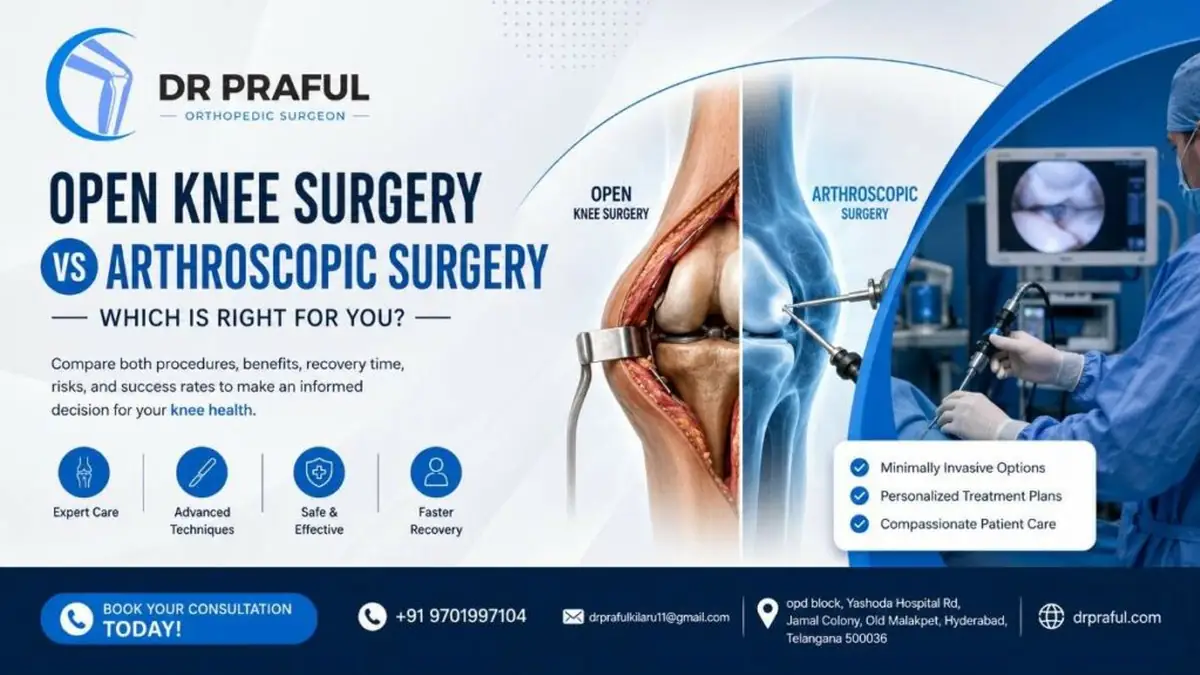
Open knee surgery vs arthroscopic surgery is one of the most common comparisons patients make when exploring treatment options for knee injuries or joint problems. While both procedures are designed to relieve pain, restore mobility, and improve knee function, they differ significantly in terms of surgical technique, recovery time, incision size, and the conditions they treat.
In most cases, arthroscopic knee surgery is preferred because it is minimally invasive, causes less pain, and allows for faster recovery. However, open knee surgery remains the recommended approach for complex knee conditions, including advanced arthritis, complicated fractures, severe injuries, joint infections, and procedures that require direct visualization of the knee joint. The right option depends on your diagnosis, overall health, and your orthopedic surgeon’s recommendation.
Quick Answer
If you’re wondering whether open knee surgery or arthroscopic surgery is better, here’s the simple answer:
- Arthroscopic surgery is ideal for treating ligament injuries, meniscus tears, cartilage damage, and many sports injuries using small incisions and a tiny camera.
- Open knee surgery is recommended for severe knee damage, complex fractures, knee replacement surgery, large tumors, or infections where wider surgical access is necessary.
The right treatment depends on the severity of your knee problem rather than the procedure itself.
What Is Open Knee Surgery?
Open knee surgery is a traditional surgical procedure in which the orthopedic surgeon makes a larger incision over the knee to directly view and access the joint. This approach provides complete visibility of the bones, cartilage, ligaments, muscles, and surrounding tissues, making it suitable for complex conditions that cannot be effectively treated through minimally invasive techniques.
Unlike arthroscopic surgery, open knee surgery provides the surgeon with direct access to the knee joint, making it possible to perform complex repairs, joint replacements, and reconstructive procedures that require greater visibility and working space.
Open knee surgery may be recommended for:
- Total knee replacement
- Partial knee replacement
- Complex fractures around the knee
- Severe ligament injuries
- Extensive cartilage damage
- Bone tumors
- Joint infections
- Revision knee surgery
- Multiple ligament reconstruction
Although open surgery involves a longer recovery period, it remains the gold standard for several advanced orthopedic procedures.
What Is Arthroscopic Knee Surgery?
Arthroscopic knee surgery is a minimally invasive surgical procedure that uses a thin instrument called an arthroscope, which contains a tiny camera and light source. Instead of making one large incision, the surgeon creates two or three small incisions through which the camera and specialized surgical instruments are inserted.
The camera projects high-definition images of the inside of the knee onto a monitor, allowing the surgeon to diagnose and treat many knee conditions with exceptional precision.
Because the surrounding muscles and tissues experience minimal disruption, patients generally experience:
- Less postoperative pain
- Smaller scars
- Reduced blood loss
- Lower infection risk
- Faster recovery
- Earlier return to daily activities
Today, arthroscopic surgery has become one of the most commonly performed orthopedic procedures worldwide.
Open Knee Surgery vs Arthroscopic Surgery: Key Differences
Feature
Open Knee Surgery
Arthroscopic Knee Surgery
Surgical Technique
Traditional open procedure
Minimally invasive procedure
Incision Size
Large incision
Two or three small incisions
Camera Used
No
Yes
Tissue Damage
More
Minimal
Blood Loss
Higher
Lower
Pain After Surgery
Moderate to high
Mild to moderate
Hospital Stay
2–5 days (varies by procedure)
Same day or 1 day
Recovery Time
Longer
Faster
Return to Daily Activities
Several weeks to months
Usually within a few weeks
Risk of Infection
Slightly higher
Lower
Scar Size
Larger
Small, less noticeable scars
Best For
Complex knee conditions
Meniscus tears, ligament injuries, sports injuries
When Is Open Knee Surgery Recommended?
Although minimally invasive surgery has become increasingly popular, open surgery is still necessary in many situations where arthroscopy cannot provide adequate access or treatment.
Your orthopedic surgeon may recommend open knee surgery if you have:
Advanced Knee Arthritis
Patients with severe osteoarthritis and significant joint damage often require total or partial knee replacement, which is performed through an open surgical approach.
Complex Knee Fractures
Fractures involving multiple bone fragments usually require open reduction and internal fixation (ORIF) to restore proper alignment and stability.
Severe Joint Deformities
Significant deformities affecting knee alignment may require open corrective procedures.
Revision Knee Surgery
Patients with a failed or worn-out knee implant may require revision knee surgery. This complex procedure is typically performed using an open surgical approach to remove or replace the existing implant and restore proper knee function.
Knee Infections
Deep infections affecting the knee joint sometimes require open surgical cleaning (debridement) to remove infected tissue thoroughly.
Bone Tumors
Tumors involving the knee bones often require open surgery for complete removal while preserving surrounding healthy tissue whenever possible.
When Is Arthroscopic Knee Surgery Recommended?
Arthroscopy is suitable for many knee conditions that involve soft tissues, cartilage, and certain joint problems.
Common indications include:
Meniscus Tears
Damaged meniscus tissue can often be repaired or trimmed through arthroscopic surgery with excellent outcomes.
ACL Injuries
Anterior cruciate ligament (ACL) reconstruction is commonly performed using arthroscopic techniques.
PCL Injuries
Posterior cruciate ligament injuries may also be treated arthroscopically depending on their severity.
Cartilage Damage
Loose cartilage fragments or localized cartilage injuries can be repaired or removed through minimally invasive surgery.
Sports Injuries
Many athletes undergo arthroscopy for sports-related knee injuries because of the faster recovery.
Loose Bodies Inside the Knee
Small fragments of cartilage or bone floating inside the joint can be removed arthroscopically.
Synovitis
Inflamed joint lining can be treated by arthroscopic synovectomy.
Knee Locking
Mechanical locking caused by torn cartilage or loose bodies is commonly corrected using arthroscopy.
Conditions Treated by Both Procedures
Depending on severity, both open surgery and arthroscopy may be used for:
- Meniscus injuries
- Ligament injuries
- Cartilage damage
- Knee instability
- Loose bodies
- Joint stiffness
- Chronic knee pain
- Certain fractures
The choice depends on:
- Extent of injury
- Patient age
- Activity level
- Previous surgeries
- Overall knee condition
- Surgeon’s clinical assessment
Benefits of Open Knee Surgery
Open knee surgery offers several advantages in complex orthopedic cases.
Advantages include:
- Better visualization of the entire knee joint
- Ideal for major reconstructive procedures
- Suitable for knee replacement surgery
- Allows treatment of severe bone damage
- Effective for complicated fractures
- Better access for revision surgeries
- Enables correction of significant deformities
- Can address multiple complex problems in a single procedure
Although recovery is longer, open surgery often provides the most effective solution for advanced knee conditions.
Benefits of Arthroscopic Knee Surgery
Arthroscopic surgery has transformed orthopedic care by offering effective treatment with minimal disruption to healthy tissues.
Benefits include:
- Smaller incisions
- Less postoperative pain
- Faster recovery
- Lower risk of infection
- Minimal blood loss
- Reduced hospital stay
- Smaller scars
- Earlier return to work and sports
- Better cosmetic results
- Lower risk of joint stiffness
For many patients, arthroscopy provides excellent outcomes while allowing a quicker return to normal life.
Limitations of Each Procedure
Open Knee Surgery
- Larger incision
- More postoperative pain
- Longer rehabilitation
- Higher blood loss
- Increased hospital stay
- Larger surgical scar
Arthroscopic Surgery
- Not suitable for severe arthritis
- Cannot treat every fracture
- Limited access for extensive reconstruction
- May not be appropriate for complex revision surgeries
- Requires specialized equipment and expertise
How Are Open Knee Surgery and Arthroscopic Surgery Performed?
Although both procedures aim to treat knee problems, the surgical approach is very different. Understanding how each surgery is performed can help patients know what to expect before and after the procedure.
Open Knee Surgery Procedure
Open knee surgery is performed under general or regional anesthesia. The orthopedic surgeon makes a larger incision over the knee to gain direct access to the joint. This allows the surgeon to clearly visualize the bones, cartilage, ligaments, and surrounding tissues, making it easier to perform complex procedures.
The exact steps vary depending on the condition being treated, but the procedure generally includes:
- Administration of anesthesia
- Cleaning and sterilizing the surgical area
- Making a larger incision over the knee
- Exposing the knee joint
- Repairing or replacing the damaged structures
- Closing the incision with sutures or staples
- Applying a sterile dressing and bandage
Open surgery is commonly performed for knee replacement, complex fractures, severe ligament injuries, revision surgery, and advanced arthritis.
Arthroscopic Knee Surgery Procedure
Arthroscopic surgery is a minimally invasive procedure performed through two or three small incisions around the knee. A tiny camera called an arthroscope is inserted through one incision, while specialized surgical instruments are introduced through the others.
The camera displays high-definition images of the inside of the knee on a monitor, allowing the surgeon to diagnose and treat the problem without opening the entire joint.
The procedure typically involves:
- Administration of anesthesia
- Creating two or three small incisions
- Inserting the arthroscope into the knee joint
- Filling the joint with sterile fluid for better visibility
- Repairing or removing damaged tissue using specialized instruments
- Removing the instruments and closing the small incisions
Because less tissue is disturbed, arthroscopic surgery usually results in less pain, minimal scarring, and a quicker recovery.
Open Knee Surgery vs Arthroscopic Surgery: Detailed Comparison
Recovery Time: Open Knee Surgery vs Arthroscopic Surgery
Recovery time varies depending on the type of surgery, the patient’s age, overall health, and commitment to rehabilitation.
Recovery After Open Knee Surgery
Since open surgery involves a larger incision and greater tissue disruption, recovery is generally longer.
Most patients can expect:
- Hospital stay of 2–5 days, depending on the procedure
- Walking with assistance within 1–3 days
- Physiotherapy starting soon after surgery
- Return to desk work in 6–8 weeks
- Return to physically demanding work in 3–6 months
- Complete recovery in 3–12 months, depending on the surgery performed
Patients undergoing total knee replacement or complex reconstructive procedures may require a longer rehabilitation period.
Recovery After Arthroscopic Knee Surgery
Recovery after arthroscopy is usually much faster because only small incisions are made and healthy tissues are preserved.
Typical recovery includes:
- Same-day discharge in many cases
- Walking with support within 24–48 hours
- Mild swelling for a few days
- Return to office work in 1–2 weeks
- Return to sports in 2–6 months, depending on the procedure
- Complete recovery generally within 6 weeks to 6 months, based on the condition treated
Following the rehabilitation program prescribed by your orthopedic surgeon and physiotherapist is essential for achieving the right results.
Which Surgery Causes Less Pain?
Pain levels differ because the amount of tissue disruption is not the same.
Open Knee Surgery
Patients usually experience:
- More postoperative pain
- Greater swelling
- Increased stiffness during the first few weeks
- Longer need for pain medications
However, modern pain management techniques, including nerve blocks and multimodal pain control, help improve comfort after surgery.
Arthroscopic Surgery
Most patients experience:
- Less postoperative pain
- Smaller wounds
- Reduced swelling
- Earlier knee movement
- Faster rehabilitation
Because arthroscopy causes less trauma to surrounding tissues, patients often resume normal activities sooner.
Risks and Complications
Like all surgical procedures, both open knee surgery and arthroscopic surgery carry certain risks. Fortunately, serious complications are uncommon when the procedures are performed by an experienced orthopedic surgeon.
Risks of Open Knee Surgery
Potential complications include:
- Infection
- Excessive bleeding
- Blood clots (deep vein thrombosis)
- Nerve or blood vessel injury
- Joint stiffness
- Delayed wound healing
- Scar formation
- Implant-related complications (in knee replacement surgery)
Risks of Arthroscopic Knee Surgery
Although minimally invasive, arthroscopy also carries some risks, including:
- Infection
- Bleeding
- Temporary swelling
- Blood clots
- Injury to surrounding nerves or blood vessels
- Persistent knee pain
- Incomplete symptom relief
- Rare instrument-related complications
Following your surgeon’s postoperative instructions and attending follow-up appointments can significantly reduce the risk of complications.
Success Rates of Open Knee Surgery vs Arthroscopic Surgery
Open Knee Surgery
- Total knee replacement
- Partial knee replacement
- Complex fracture repair
- Revision knee surgery
- Tumor removal
Many patients experience significant pain relief and improved mobility after recovery.
Arthroscopic Knee Surgery
- Meniscus repair
- ACL reconstruction
- Cartilage procedures
- Removal of loose bodies
- Treatment of sports-related knee injuries
Most patients recover well and return to their normal activities with improved knee function.
Cost Comparison
The cost of surgery depends on several factors, including the type of procedure, hospital charges, surgeon’s experience, implants (if required), and postoperative rehabilitation.
In general:
- Arthroscopic surgery may involve lower overall costs due to shorter hospital stays and quicker recovery.
- Open knee surgery, especially knee replacement or complex reconstructive procedures, may cost more because of longer operating times, implants, hospitalization, and rehabilitation.
Which Procedure Is Better?
There is no single answer to whether open knee surgery or arthroscopic surgery is better. The right choice depends on the nature and severity of your knee problem.
Arthroscopic surgery may be the better option if you have:
- Meniscus tears
- ACL or PCL injuries
- Sports-related knee injuries
- Loose cartilage or bone fragments
- Mild to moderate cartilage damage
- Knee locking caused by soft tissue problems
Open knee surgery may be recommended if you have:
- Advanced knee arthritis requiring replacement
- Complex fractures
- Multiple ligament injuries
- Severe joint deformities
- Bone tumors
- Deep joint infections
- Failed previous knee surgery requiring revision
The best outcomes are achieved when the procedure is selected based on an accurate diagnosis, imaging findings, your activity level, and your long-term goals.
1. Which Is Better: Open Knee Surgery or Arthroscopic Surgery?
Neither procedure is universally better—the right choice depends on your knee condition. Arthroscopic surgery is generally preferred for meniscus tears, ligament injuries, cartilage damage, and many sports injuries because it is minimally invasive and offers a faster recovery. Open knee surgery is recommended for complex fractures, severe arthritis requiring knee replacement, revision surgery, or conditions that require direct access to the knee joint.
2. Is Arthroscopic Knee Surgery Less Painful Than Open Knee Surgery?
Yes. Arthroscopic knee surgery usually causes less postoperative pain because it uses small incisions and causes minimal damage to surrounding tissues. Most patients experience less swelling, smaller scars, and a quicker recovery compared to open knee surgery.
3. How Long Does It Take to Recover from Open Knee Surgery?
Recovery depends on the type of surgery performed. Most patients begin walking with assistance within a few days, but complete recovery may take 3 to 12 months, especially after knee replacement or complex reconstructive procedures. Physiotherapy is an essential part of the recovery process.
4. How Long Does Recovery Take After Arthroscopic Knee Surgery?
Recovery after arthroscopic surgery is generally faster. Many patients return to desk work within 1–2 weeks and resume normal daily activities within 4–6 weeks. Athletes or patients undergoing ligament reconstruction may require several months of rehabilitation before returning to sports.
5. Can Knee Replacement Be Performed Arthroscopically?
No. Total and partial knee replacement surgeries are performed using an open surgical approach because the damaged joint surfaces must be removed and replaced with artificial implants. Arthroscopy is not suitable for knee replacement procedures.
6. What Conditions Can Be Treated with Arthroscopic Knee Surgery?
Arthroscopic surgery is commonly used to treat:
- Meniscus tears
- ACL and PCL injuries
- Cartilage damage
- Loose bone or cartilage fragments
- Synovitis
- Knee locking
- Some sports-related knee injuries
Your orthopedic surgeon will determine whether arthroscopy is appropriate based on the severity of your condition.
7. What Are the Risks of Open Knee Surgery and Arthroscopic Surgery?
Both procedures are considered safe when performed by an experienced orthopedic surgeon. However, potential risks include:
- Infection
- Bleeding
- Blood clots
- Nerve or blood vessel injury
- Knee stiffness
- Persistent pain
- Delayed healing
Following your surgeon’s postoperative instructions and attending rehabilitation sessions can help minimize these risks.
8. When Should I See an Orthopedic Surgeon?
You should consult an orthopedic surgeon if you experience:
- Persistent knee pain
- Swelling that does not improve
- Knee instability or frequent giving way
- Difficulty walking or climbing stairs
- Knee locking
- Reduced range of motion
- Pain following a sports injury or accident
- Symptoms that interfere with your daily activities
Early evaluation can help identify the underlying problem and prevent further joint damage.
Key Takeaways
- Open knee surgery and arthroscopic surgery are both effective treatments for knee conditions, but they are used for different purposes.
- Arthroscopic surgery is a minimally invasive procedure that is ideal for treating meniscus tears, ligament injuries, cartilage damage, and many sports injuries.
- Open knee surgery is typically recommended for complex fractures, severe arthritis requiring knee replacement, revision surgery, infections, and major reconstructive procedures.
- Arthroscopy generally offers smaller incisions, less pain, reduced scarring, and faster recovery, while open surgery provides better access for treating complex knee conditions.
- Choosing the right procedure depends on an accurate diagnosis, imaging findings, your activity level, and the expertise of your orthopedic surgeon.
Conclusion
Understanding the differences between open knee surgery vs arthroscopic surgery can help you make informed decisions about your treatment. While arthroscopic surgery has become the preferred option for many knee conditions because of its minimally invasive approach and faster recovery, open knee surgery remains the most effective solution for advanced arthritis, complex fractures, knee replacement, revision procedures, and other conditions requiring extensive surgical repair.
Rather than focusing on which procedure is “better,” it’s more important to determine which one is most appropriate for your specific diagnosis. A thorough evaluation by an experienced orthopedic surgeon, including a physical examination and imaging studies, will help identify the most suitable treatment plan for your condition. Early diagnosis and timely treatment can relieve pain, restore mobility, and help you return to your daily activities with improved knee function.
This article is for general information and does not replace a medical consultation. For advice about your condition, book an appointment with Dr. Praful Kilaru. For more patient information, see AAOS OrthoInfo: Knee arthroscopy.