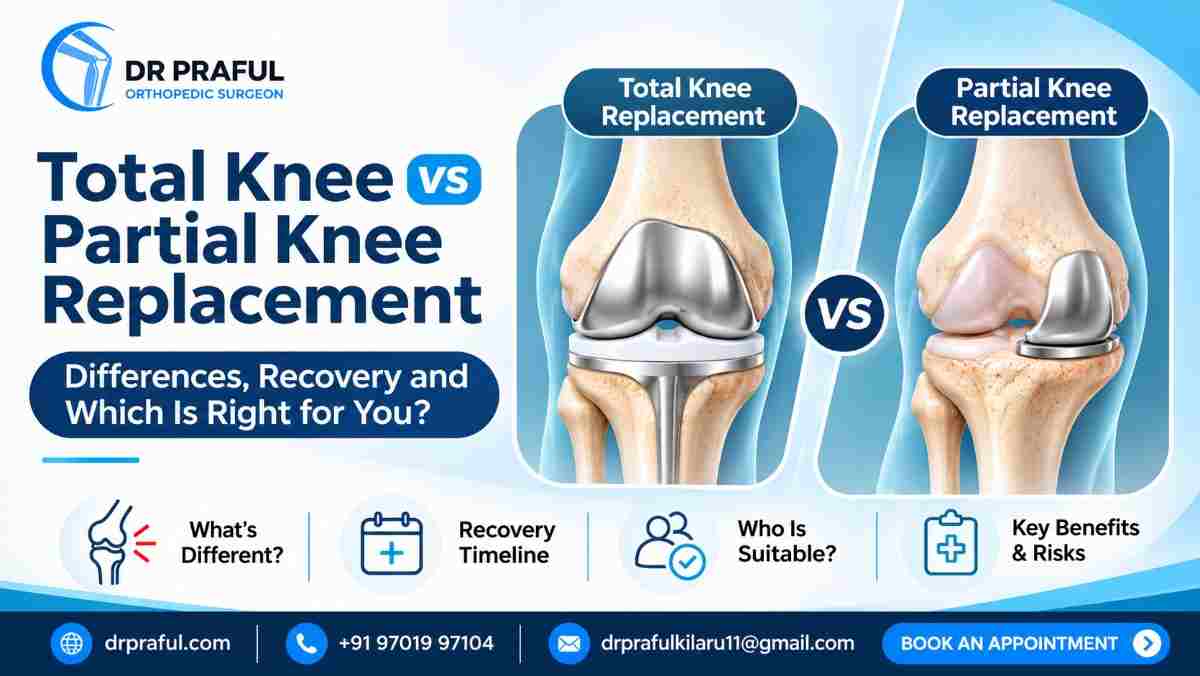
In total knee vs partial knee replacement, the main difference is how much of the knee is replaced. A total knee replacement resurfaces the whole joint and suits arthritis that affects most of the knee. A partial knee replacement replaces only the one worn part and keeps the healthy cartilage and ligaments. Partial replacement usually means a smaller cut, faster recovery and a more natural-feeling knee, but it is suitable only when arthritis is limited to one area. Total replacement suits far more patients and tends to last longer before needing further surgery.
Reviewed by Dr. Praful Kilaru, Senior Consultant Joint Replacement & Complex Trauma Surgeon, Yashoda Hospitals, Malakpet, Hyderabad.
Total vs Partial Knee Replacement at a Glance
The table below compares the two operations side by side.
Feature
Total knee replacement
Partial knee replacement
What is replaced
All three parts of the knee
Only the worn part, usually the inner side
Who it suits
Arthritis across the knee, deformity, rheumatoid arthritis
Arthritis in one part only, with healthy ligaments
Incision
Longer
Usually smaller
Hospital stay
Usually a few days
Often shorter
Walking with support
From the first day or two
From the first day or two
Return to daily activities
About 6–12 weeks
Often about 3–6 weeks
How the knee feels
Very good, but may feel less natural
Often feels more natural
Bending
Good
Often slightly better
Chance of needing further surgery
Lower
Higher over 10–15 years
Later options
Revision surgery if needed
Can be converted to a total knee replacement
These are typical figures. Your own recovery depends on your age, health, the state of your knee and how regularly you do your exercises.
What Is a Total Knee Replacement?
In a total knee replacement, the surgeon removes the worn surfaces from the end of the thigh bone, the top of the shin bone and, in many cases, the back of the kneecap, and replaces them with metal and medical-grade plastic parts.
It is the most commonly performed knee replacement and works well for arthritis that affects the whole knee, a bow-legged or knock-kneed deformity, and inflammatory arthritis such as rheumatoid arthritis. Learn more on our page on total knee replacement surgery in Hyderabad.
What Is a Partial Knee Replacement?
A partial knee replacement, also called a unicompartmental or "uni" knee replacement, replaces only the damaged part of the knee. The knee has three parts: the inner side, the outer side and the area behind the kneecap. Arthritis most often starts on the inner side.
Because the healthy cartilage, bone and ligaments, including the ACL, are kept, the knee often bends more freely and feels closer to a natural knee.
Who Is Suitable for a Partial Knee Replacement?
Only a smaller group of patients are good candidates. You may be suitable if:
- Arthritis is limited to one part of the knee
- Your ligaments, especially the ACL, are healthy
- Your knee is stable and bends reasonably well
- Any bowing or knock-knee deformity is mild
- You do not have inflammatory arthritis such as rheumatoid arthritis
Partial replacement is usually not advised when arthritis affects more than one part of the knee, when the ligaments are damaged, or when the knee is very stiff or badly deformed. In these cases, a total knee replacement gives a more reliable result.
How Do Doctors Decide Between Total and Partial?
The choice depends on your knee, not on preference alone. The surgeon looks at:
- Standing X-rays: to see which parts of the knee are worn and how much; read our guide to knee arthritis grades
- Examination: checking ligament stability, range of movement and alignment
- MRI, if needed: to check the cartilage in the other parts of the knee and the ligaments
- Your age, activity level and general health
- Findings during surgery: occasionally the knee is more worn inside than the scans showed, and the plan changes to a total replacement
Ask before surgery
If you are hoping for a partial knee replacement, ask your surgeon before the operation what happens if more damage is found inside the knee. Most surgeons will explain whether they may switch to a total replacement during the same operation.
Benefits of Partial Knee Replacement
For the right patient, partial knee replacement offers several advantages:
- A smaller incision and less tissue disturbance
- Less blood loss and often less pain in the first weeks
- A shorter hospital stay and faster return to daily activities
- Better bending and a more natural-feeling knee for many people
- Healthy bone and ligaments are preserved, which can help if further surgery is needed later
Benefits of Total Knee Replacement
Total knee replacement remains the standard choice for most people with knee arthritis because:
- It suits arthritis in any part, or all parts, of the knee
- It corrects deformities such as bow legs
- It gives reliable pain relief in most patients
- It has a lower chance of needing further surgery over the long term
To see how long modern implants usually last, read how long does a knee replacement last?
Recovery: Total vs Partial
Recovery stage
Total knee replacement
Partial knee replacement
Standing and walking with support
Usually day 1
Usually day 1, sometimes the same day
Going home
Usually after a few days
Often sooner
Walking without support
About 3–6 weeks
About 2–4 weeks
Daily activities
About 6–12 weeks
About 3–6 weeks
Full recovery
About 6–12 months
About 3–6 months
Recovery times vary. Regular physiotherapy is essential after both operations. For a week-by-week guide, see our knee replacement recovery timeline.
How Long Do They Last?
Both types of implant can last many years. Large joint registries show that most total knee replacements are still working 15–20 years or more after surgery.
Partial knee replacements also work well for many years, but registry data show they need further surgery more often than total replacements over 10–15 years. Common reasons include arthritis developing in another part of the knee or the implant loosening. If this happens, a partial knee can usually be converted to a total knee replacement; see our page on knee revision surgery.
Risks of Each Operation
Both operations are generally safe, and serious complications are uncommon. Possible risks include:
- Infection
- Blood clots in the leg
- Stiffness
- Ongoing pain or swelling
- Loosening or wear of the implant over time
- Nerve or blood vessel injury, which is rare
Partial replacement may have a slightly lower risk of some early complications, while total replacement has a lower long-term chance of needing further surgery. Your surgeon will explain your personal risks.
Cost: Total vs Partial Knee Replacement
The cost of either operation depends on the hospital, the implant chosen, whether robotic assistance is used, your room category and your length of stay. A partial knee replacement can sometimes cost less because of a shorter stay, but this is not always the case.
Most health insurance policies cover both operations. For a detailed breakdown, see our guide to knee replacement surgery cost in Hyderabad.
Robotic Knee Replacement: Does It Apply to Both?
Yes. Robotic-assisted systems can be used for both total and partial knee replacement. The robot helps the surgeon plan and position the implant precisely, but the surgeon performs the operation and makes the decisions. Robotic assistance is not needed for every patient. Read more about robotic knee replacement cost in Hyderabad.
Which One Is Right for You?
A partial knee replacement may suit you if your arthritis is confined to one part of the knee, your ligaments are healthy and your knee is not badly deformed. A total knee replacement is usually the better choice if arthritis affects more than one part of the knee, you have a significant deformity or inflammatory arthritis, or you want the option with the lowest chance of further surgery.
The right decision comes from a careful examination and X-rays. Before surgery, read the signs you need knee replacement surgery, and learn about the full range of options on our knee replacement surgery in Hyderabad page.
Knee Replacement with Dr. Praful Kilaru in Hyderabad
Dr. Praful Kilaru is a Senior Consultant Joint Replacement and Complex Trauma Surgeon at Yashoda Hospitals, Malakpet, Hyderabad, with 18 years of orthopaedic experience. He assesses each knee carefully and explains which type of knee replacement, if any, suits your condition. Learn more about his orthopaedic practice in Hyderabad, or book a consultation and bring your knee X-rays with you.
Frequently Asked Questions: Total vs Partial Knee Replacement
Is partial knee replacement better than total knee replacement?
Neither is better for everyone. Partial replacement often gives a faster recovery and a more natural-feeling knee, but only suits arthritis in one part of the knee. Total replacement suits more patients and has a lower chance of needing further surgery.
Who is not a candidate for partial knee replacement?
People with arthritis in more than one part of the knee, damaged ligaments, a very stiff or badly deformed knee, or inflammatory arthritis such as rheumatoid arthritis are usually better suited to total knee replacement.
Is partial knee replacement less painful?
Many people have less pain in the first few weeks after a partial knee replacement because the operation is smaller. Pain after either operation is controlled with medicines and improves with time. See is knee replacement painful?
How long does a partial knee replacement last?
Many partial knee replacements work well for 10–15 years or longer. They need further surgery more often than total replacements, usually because arthritis develops in another part of the knee.
Can a partial knee replacement be converted to a total knee replacement?
Yes. If the partial replacement wears out or arthritis spreads to another part of the knee, it can usually be converted to a total knee replacement.
Which recovers faster, partial or total knee replacement?
Partial knee replacement usually recovers faster. Many people return to daily activities in about 3–6 weeks, compared with about 6–12 weeks after a total knee replacement.
Is partial knee replacement cheaper?
It can be, mainly because of a shorter hospital stay, but the final cost depends on the hospital, implant, robotic assistance and room type. Both are usually covered by health insurance.
Can I sit cross-legged or squat after knee replacement?
Many people bend their knee further after a partial replacement. After either operation, deep squatting and sitting cross-legged may be possible for some people but are not guaranteed, and some surgeons advise caution. Ask your surgeon about your own knee.
Can both knees have partial knee replacement?
Yes, if both knees meet the conditions for a partial replacement. The surgeon will assess each knee separately.
Is robotic surgery used for partial knee replacement?
Yes. Robotic assistance can be used for both partial and total knee replacement to help plan and position the implant accurately. It is not essential for every patient.
Medical disclaimer: This article is for general information and does not replace a medical examination. The right type of knee replacement depends on your individual knee. Please consult a qualified orthopaedic surgeon.
References: AAOS OrthoInfo: Unicompartmental Knee Replacement · AAOS OrthoInfo: Total Knee Replacement · NHS: Knee replacement