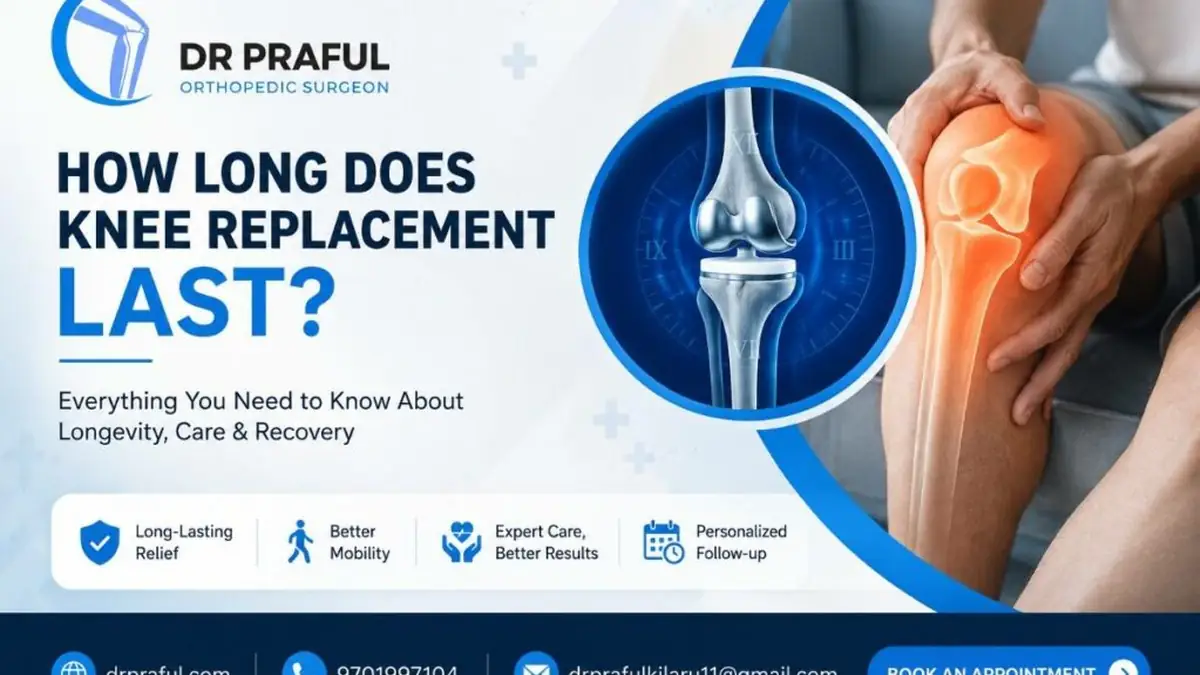
If you are considering knee replacement surgery, one of the first questions you may have is: “How long does a knee replacement last?” Most modern knee replacements can last at least 15–20 years, and many continue functioning well beyond that.
However, there is no fixed expiry date for a knee implant. Its lifespan can vary depending on your age, body weight, activity level, implant positioning, bone quality, general health and whether complications develop.
The good news is that a well-planned knee replacement combined with appropriate activity, rehabilitation and regular follow-up can provide many years of pain relief and improved mobility.
How Long Does Knee Replacement Last? Survival at 15, 20 and 25 Years
A systematic review and meta-analysis published in The Lancet examined long-term knee replacement survival using published studies and national joint-replacement registry data.
For total knee replacements, pooled registry data showed:
Time after surgery
Approximate total knee replacement survival
15 years
About 93%
20 years
About 90%
25 years
About 82%
These figures are population-level estimates. They cannot predict exactly how long an individual person’s knee replacement will last.
Knee Replacement in Hyderabad
If you are considering knee replacement in Hyderabad, the decision should be based on your symptoms, imaging, physical examination, overall health, age, activity goals and the extent of knee damage.
At Dr. Praful Kilaru’s orthopedic practice, patients can be evaluated for knee arthritis, knee replacement, revision knee replacement and other joint-related conditions.
The aim is not just to replace the damaged joint, but to restore comfortable and functional movement.
It is to select the appropriate treatment and help the patient achieve safe, long-term function.
How many years does a knee replacement usually last?
A modern knee replacement can often remain functional for 15–20 years or longer. The exact lifespan varies from person to person and depends on factors such as age, body weight, activity level, implant type, surgical technique, and overall joint health.
Can a knee replacement last 25 years?
Yes.
Can a knee replacement last 30 years?
Some knee replacements may function for 30 years or longer, but the available evidence does not mean that every implant will last that long. Individual lifespan depends on patient and implant factors.
What Factors Affect the Lifespan of a Knee Replacement?
Wear, loosening, infection, instability, fracture and other mechanical or biological problems can lead to failure or the need for revision.
Does walking wear out a knee replacement?
Normal walking does not mean that a knee replacement will quickly wear out. In fact, walking is generally an appropriate low-impact activity after recovery. Excessive high-impact activity may increase wear and stress on the implant.
Can I run after knee replacement?
Running is generally considered a high-impact activity and is usually discouraged after total knee replacement. Discuss your individual activity goals with your orthopedic surgeon.
What are the signs that a knee replacement is failing?
Increasing pain, swelling, instability, stiffness, reduced function or symptoms after an injury can indicate a problem. These symptoms require evaluation because they can have several different causes.
What happens if a knee replacement fails?
Depending on the cause, treatment may include observation, physiotherapy, medication, treatment of infection or revision knee replacement.
Is revision knee replacement more difficult?
Yes. Revision surgery is generally more complex than primary knee replacement because the surgeon may need to remove existing components and manage bone loss or soft-tissue problems.
What can I do to make my knee replacement last longer?
Maintain a healthy weight, stay active with appropriate low-impact exercise, follow your rehabilitation program, avoid unnecessary high-impact activities, prevent falls and attend recommended follow-up appointments.
Key Takeaway
A knee replacement does not have a fixed expiration date.
For most people, a modern knee replacement can last 15 to 20 years or longer, and long-term registry evidence suggests that approximately 82% of total knee replacements are still functioning after 25 years.
The lifespan of an individual knee replacement depends on several factors, including age, body weight, activity level, implant positioning, bone quality, infection, injury and other complications.
If you have a knee replacement that is becoming painful, swollen, stiff or unstable after years of good function, do not assume that it simply needs to be replaced. An orthopedic assessment can help identify the actual cause and determine the appropriate treatment.
Medical References
- Evans JT, et al. How long does a knee replacement last? A long-term review of clinical studies and national joint registry data tracking knee replacement outcomes for more than 15 years. The Lancet. 2019.
- American Academy of Orthopaedic Surgeons. Total Knee Replacement.
- Mayo Clinic. Knee Replacement.
- NHS. What is a knee replacement?
- National Joint Registry / NCBI Bookshelf. Long-term survival of knee replacements.
Medical Disclaimer
This article is for general educational purposes and does not replace an examination or personalized medical advice from a qualified orthopedic professional. If you have persistent or worsening symptoms after knee replacement, consult your orthopedic surgeon. For more patient information, see AAOS OrthoInfo: Total knee replacement.
Frequently Asked Questions
Can Your Knee Replacement Stay Strong for 25 Years?
Yes. A knee replacement can last 25 years or longer in some patients.
The long-term evidence is encouraging. A meta-analysis published in The Lancet found that approximately 82% of total knee replacements were still functioning 25 years after surgery.
This does not mean that every implant will reach 25 years.
A younger, heavier or highly active patient may place different stresses on an implant than an older patient with lower-impact activity. Surgical technique, implant positioning, bone quality, infection, injury and other individual factors can also affect longevity.
Therefore, it is better to think of 15, 20 or 25 years as population-level survival milestones rather than an expiration date
What Factors Affect How Long a Knee Replacement Lasts?
Several factors can influence the lifespan of a knee replacement.
1. Age at the Time of Surgery
Age can influence the likelihood of needing another operation during a person’s lifetime.
For example, someone who has a knee replacement at 50 may place decades of additional demands on the implant compared with someone who undergoes the same procedure at 75.
That does not mean younger patients should avoid knee replacement when it is medically necessary. It means implant longevity and the possibility of future revision should be part of the discussion before surgery.
2. Body Weight
Body weight affects the mechanical load placed on the knee during everyday activities.
Higher body weight can increase stress on the joint replacement and may contribute to wear or other problems.
Maintaining a healthy weight after surgery can therefore be an important part of protecting the new knee.
3. Activity Level
Regular movement is important after knee replacement, but not every type of activity places the same stress on an implant.
AAOS notes that excessive activity or weight may accelerate wear of the plastic spacer and potentially contribute to loosening and pain. It generally recommends low-impact activities and advises against high-impact activities such as running, jogging and jumping after total knee replacement.
Activities such as:
- Walking
- Swimming
- Cycling
- Golf
- Light hiking
are generally more joint-friendly than repetitive high-impact activities. Your surgeon should guide you on which activities are appropriate for your individual recovery.
4. Implant Positioning and Surgical Technique
Accurate positioning of the implant is an important part of knee replacement surgery.
Your orthopedic surgeon plans the procedure based on your bone anatomy, alignment, ligament balance and other factors.
Modern knee replacement techniques continue to evolve, but long-term implant survival depends on multiple factors rather than one surgical technique alone.
5. Bone Quality
The strength and condition of the bone surrounding the implant can influence fixation and stability.
Your surgeon considers your bone quality when planning the procedure and selecting the appropriate fixation and implant strategy.
6. Infection
Infection after knee replacement is uncommon but can be a serious complication.
An infection involving the artificial joint may require prolonged treatment and, in some cases, additional surgery.
7. Injury or Fracture
A significant fall or accident can damage the bones around a knee replacement or affect the implant.
This is one reason fall prevention and maintaining leg strength are important after surgery.
What Happens to Your Knee Implant After Several Years?
A knee replacement is made from durable artificial components, but it is not indestructible.
With normal use, the plastic spacer inside a total knee replacement can gradually wear.
Over many years, wear particles may contribute to inflammation and changes around the implant. In some patients, the implant can eventually loosen or develop other problems.
This does not mean that normal walking will quickly “wear out” the knee.
For most patients, the goal is to restore mobility, reduce pain and allow a return to appropriate daily activities.
What Are the Warning Signs of Knee Replacement Failure?
A knee replacement does not automatically need replacement simply because it is old.
Any new or worsening symptoms should be assessed by an orthopedic specialist.
Possible warning signs include:
- Increasing knee pain after a period of improvement
- New swelling
- Increasing stiffness
- A feeling that the knee is unstable
- Difficulty walking
- New clicking or unusual sensations accompanied by pain
- Reduced ability to perform normal activities
- Persistent warmth or redness
- Fever or other symptoms that may suggest infection
- Pain following a significant fall or injury
These changes may have different causes and should not immediately be assumed to mean implant failure.
Pain can have many causes, so an orthopedic evaluation is important before assuming that revision surgery is necessary.
How Is a Problem With a Knee Replacement Diagnosed?
If a patient develops new or persistent symptoms after knee replacement, the orthopedic surgeon will first review the symptoms and medical history and perform a physical examination.
Depending on the situation, evaluation may include:
- X-rays
- Blood tests
- Additional imaging
- Assessment for infection
- Evaluation of implant alignment
- Assessment of loosening or wear
- Examination of the surrounding bones, ligaments and soft tissues
The goal is to determine why the knee is painful or functioning poorly, rather than simply deciding whether the implant is “old.”
When Is Revision Knee Replacement Needed?
Revision knee replacement is considered when an artificial knee develops a significant problem that cannot be adequately managed with nonsurgical treatment or a less extensive procedure.
Possible reasons include:
- Implant loosening
- Significant wear
- Infection
- Instability
- Fracture around the implant
- Recurrent dislocation or other mechanical problems
- Severe bone loss
- Persistent symptoms caused by a correctable implant problem
Revision knee replacement is usually more complex than the original operation because the surgeon may need to remove existing components and address bone loss or damaged tissues.
Pain after knee replacement does not always mean that revision surgery is necessary.
A proper evaluation is needed to identify what is causing the symptoms before considering further treatment.
Can a Knee Replacement Be Replaced More Than Once?
Yes, revision surgery can be performed when clinically necessary.
However, revision surgery is generally more complex than primary knee replacement.
The amount of bone and soft tissue available, the condition of the existing implant and the reason for revision all influence the surgical plan.
That is why protecting the original knee replacement and identifying problems early can be important.
How Can You Protect Your Knee Replacement for the Long Term?
You cannot guarantee a specific implant lifespan, but you can take steps that may help protect your knee.
Stay physically active
Regular low-impact exercise can help maintain:
- Muscle strength
- Joint mobility
- Balance
- General fitness
Maintain a healthy body weight
Keeping your weight in a healthy range can reduce mechanical stress on the knee.
Follow your rehabilitation program
Physiotherapy and prescribed exercises are important during recovery.
Strengthening the muscles around the knee can help restore function and confidence.
Choose joint-friendly activities
Walking, swimming and cycling are generally more appropriate after knee replacement than repetitive high-impact activities.
AAOS specifically advises against high-impact activities such as running, jogging and jumping after total knee replacement.
Prevent falls and injuries
Good balance, appropriate footwear and maintaining leg strength can help reduce the risk of falls.
Attend follow-up appointments
Your orthopedic surgeon may recommend periodic examinations and X-rays to monitor your knee replacement. AAOS recommends routine follow-up as part of long-term care.
Does Knee Replacement Lifespan Depend on the Type of Replacement?
Yes.
Total knee replacement and partial knee replacement are different procedures and should not be treated as having identical long-term outcomes.
The long-term Lancet analysis found different survival estimates for total and unicondylar knee replacements.
It is important to remember that these figures do not by themselves determine which procedure is superior.
Your orthopedic surgeon will recommend the most suitable procedure based on factors such as:
- Which parts of the knee are damaged
- Ligament condition
- Alignment
- Age
- Activity level
- Severity of arthritis
- Overall health
Your orthopedic surgeon can determine which procedure is appropriate for your knee.
Is a Knee Replacement a Lifetime Solution?
For many older adults, a knee replacement may last for the rest of their lifetime.
For younger patients, there is a greater possibility that the implant may eventually require revision simply because they have more years of activity ahead of them.
The important point is that there is no universal expiration date for a knee replacement.
Modern evidence shows that many implants continue functioning well for 15, 20 and even 25 years.
When Should You See an Orthopedic Surgeon?
Consider an orthopedic evaluation if you have:
- Persistent knee pain affecting daily activities
- Severe knee arthritis
- Difficulty walking despite conservative treatment
- Pain that has returned after successful knee replacement
- New swelling or instability
- Increasing stiffness
- Symptoms after a fall or injury
- Concerns about an older knee replacement
An orthopedic surgeon can assess the cause of your symptoms and determine whether observation, physiotherapy, medication, injections, revision surgery or another treatment is appropriate.
This article is for general information and does not replace a medical consultation. For advice about your condition, book an appointment with Dr. Praful Kilaru.