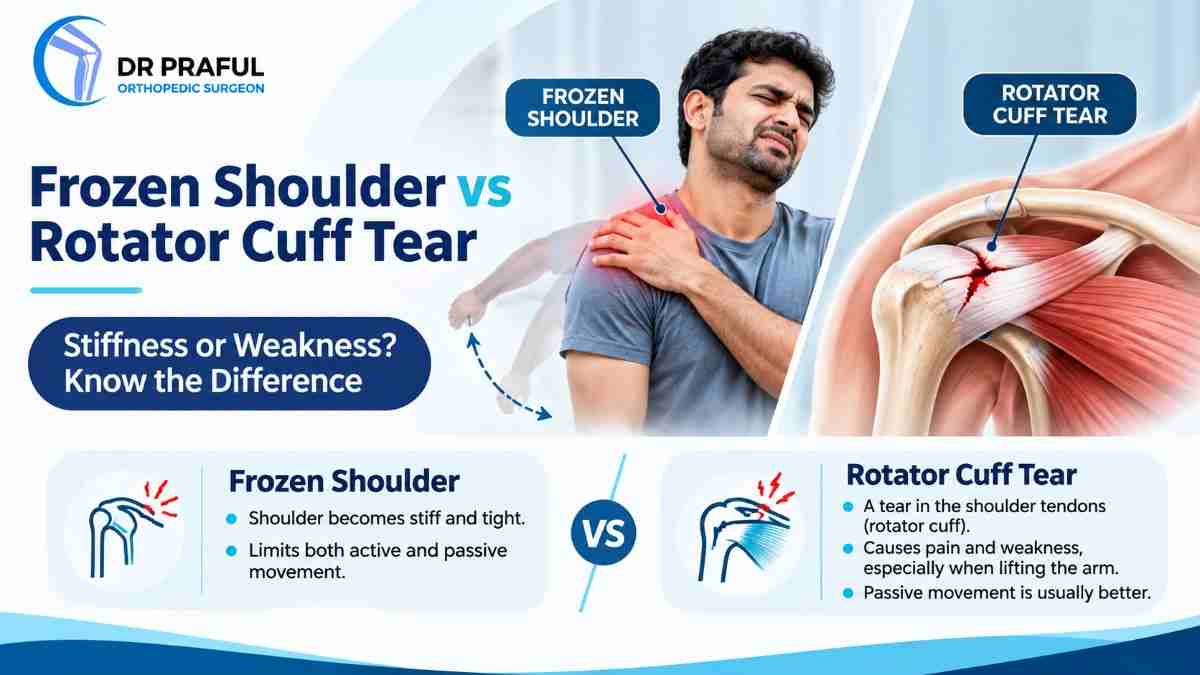
Frozen shoulder vs rotator cuff tear comes down to one simple question: is the shoulder stiff, or is it weak? In a frozen shoulder, the joint capsule tightens, so the arm will not move fully even when a doctor lifts it for you. In a rotator cuff tear, a tendon is damaged, so you struggle to lift the arm yourself, but a doctor can usually move it much further. Both cause shoulder pain and night pain, which is why they are often confused. A proper examination, and sometimes an ultrasound or MRI, confirms which one you have.
Reviewed by Dr. Praful Kilaru, Senior Consultant Joint Replacement & Complex Trauma Surgeon, Yashoda Hospitals, Malakpet, Hyderabad.
Frozen Shoulder vs Rotator Cuff Tear: Quick Comparison
The table below shows the main differences at a glance.
Feature
Frozen shoulder
Rotator cuff tear
What is affected
Joint capsule (the lining around the joint)
Tendons of the rotator cuff muscles
Main problem
Stiffness
Weakness and pain on lifting
How it starts
Slowly, often with no injury
Slowly with age or wear, or suddenly after a fall or lift
Movement when you lift the arm
Limited
Limited, painful or weak
Movement when a doctor lifts the arm
Also limited
Usually much better
Strength
Usually normal
Often reduced
Typical age
40–60 years
Over 40; sudden tears at any age
Common link
Diabetes, thyroid problems, long immobilisation
Age, overhead work, sports, falls
Usual treatment
Physiotherapy, pain relief, injection; procedure if not improving
Physiotherapy, pain relief; surgery for some tears
These are general patterns. Some people have features of both, so the table cannot replace an examination.
What Is a Frozen Shoulder?
A frozen shoulder (adhesive capsulitis) is a condition in which the capsule around the shoulder joint becomes inflamed, thick and tight. The joint itself is not worn out, but the tight capsule stops the arm from moving freely in every direction.
It is most common between the ages of 40 and 60, slightly more common in women, and much more common in people with diabetes. It can also follow thyroid problems, heart or lung illness, or a period when the arm was kept still after an injury or operation. Often there is no clear cause.
The Three Stages of Frozen Shoulder
Stage
Usual length
What you notice
Freezing (painful) stage
About 2–9 months
Pain increases, worse at night; movement slowly reduces
Frozen (stiff) stage
About 4–12 months
Pain may ease, but the shoulder is very stiff
Thawing (recovery) stage
About 6 months to 2 years
Movement slowly returns
Most people improve over 1–3 years, but treatment can ease pain and help movement return sooner. Some mild stiffness can remain.
What Is a Rotator Cuff Tear?
The rotator cuff is a group of four muscles and their tendons that hold the ball of the shoulder in its socket and help you lift and turn the arm. A rotator cuff tear is a split or tear in one or more of these tendons.
Tears happen in two main ways:
- Wear-and-tear (degenerative) tears: the tendon weakens slowly with age, overhead work or repeated lifting. These are very common after 40, and many cause few or no symptoms.
- Injury (acute) tears: a fall on an outstretched arm, a shoulder dislocation or a sudden heavy lift can tear a healthy tendon at any age.
Tears can be partial (the tendon is frayed but not torn through) or full-thickness (the tendon is torn completely, sometimes pulling off the bone). Learn more on our page on rotator cuff injury treatment in Hyderabad.
7 Key Differences Between Frozen Shoulder and Rotator Cuff Tear
Here is how the two conditions usually differ, point by point.
1. Stiffness vs Weakness
Frozen shoulder is mainly a stiffness problem: the arm feels "stuck". A rotator cuff tear is mainly a weakness problem: the arm feels heavy, tired or gives way when you lift it.
2. Active vs Passive Movement
This is the most useful test. Active movement is how far you can move your arm yourself. Passive movement is how far a doctor can move it for you while you relax. In a frozen shoulder, both are limited by the same amount. In a rotator cuff tear, passive movement is usually much better than active movement.
3. Which Movements Are Lost
Frozen shoulder typically limits turning the arm outwards (external rotation) first and most, so reaching behind the head or back becomes hard. A rotator cuff tear typically makes it hard to lift the arm out to the side or overhead, often with a painful arc between shoulder and head height.
4. How It Starts
Frozen shoulder usually starts slowly, without any injury. A rotator cuff tear may start slowly with age, or suddenly with a snap or tearing feeling after a fall or lift.
5. Type of Pain
Both cause night pain and pain when lying on the shoulder. Frozen shoulder pain is often a deep, constant ache that is worst in the early stage. Rotator cuff pain is often felt on the outer upper arm and is worse when lifting or reaching overhead.
6. Strength Testing
In a frozen shoulder, the muscles are usually strong when tested within the range that is still available. In a rotator cuff tear, the doctor often finds the arm weak when resisting pressure, especially when lifting sideways or turning outwards.
7. How They Are Treated
Most frozen shoulders get better with physiotherapy, pain relief and time. Most degenerative rotator cuff tears also start with non-surgical treatment, but some tears, especially sudden tears in active people, are better repaired with surgery.
A common mix-up
Many people with a stiff, painful shoulder are told they have a "tear", and many with a tear are told to "just keep stretching". Both can delay the right treatment. If your shoulder is stiff in every direction, or weak when lifting, get it examined rather than guessing.
Can You Have Both at the Same Time?
Yes. A painful rotator cuff tear can make you avoid moving the arm, and the shoulder can then become stiff. Both conditions are also common in people over 40 and in people with diabetes. When both are present, doctors usually work on getting movement back first, then reassess the tendon.
How Do Doctors Tell the Difference?
A careful examination usually points to the answer. Scans are used to confirm it or to plan treatment.
- History: how the pain started, any injury, diabetes or thyroid problems, and what you cannot do
- Examination: comparing active and passive movement, checking external rotation and testing the strength of each rotator cuff muscle
- X-ray: rules out arthritis, calcium deposits and fractures, which can look similar
- Ultrasound: a quick test that shows rotator cuff tears well
- MRI scan: shows the size and type of a tear, and capsule thickening in frozen shoulder
Frozen shoulder is mainly diagnosed by examination, so an MRI is not always needed. An MRI is more useful when a tear is suspected and surgery is being considered.
Treatment Options Compared
Treatment for Frozen Shoulder
- Pain relief: simple painkillers or anti-inflammatory medicines, if they are safe for you
- Physiotherapy: gentle stretches that do not force the shoulder, especially in the painful stage; see our page on physiotherapy and rehabilitation
- Steroid injection: can reduce pain in the early stage and make exercises easier
- Hydrodilatation: an injection of fluid that stretches the tight capsule
- Manipulation under anaesthesia or arthroscopic capsular release: for a stiff shoulder that does not improve after several months of treatment
People with diabetes should check their blood sugar closely after a steroid injection, as it can rise for a few days.
Treatment for a Rotator Cuff Tear
- Rest from painful activities: avoid heavy lifting and overhead work for a while, without keeping the arm completely still
- Physiotherapy: strengthens the remaining rotator cuff and shoulder blade muscles; many degenerative tears improve with this alone
- Pain relief and, in some cases, an injection to settle pain so exercises are possible
- Arthroscopic (keyhole) repair: often advised for sudden tears in active people, large tears, or tears that stay painful and weak despite about 3–6 months of physiotherapy
- Shoulder replacement: for some very large, long-standing tears with arthritis; see shoulder replacement surgery
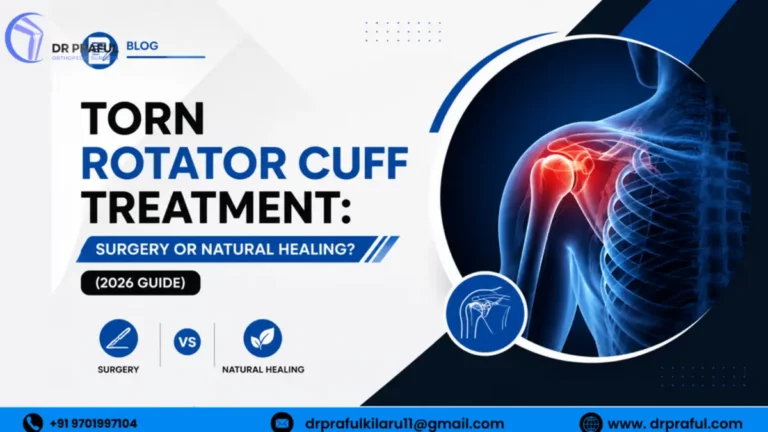
For a detailed look at surgery versus non-surgical care, read our guide on torn rotator cuff treatment.
How Long Does Recovery Take?
Situation
Typical recovery
Frozen shoulder, non-surgical care
Most improve over 1–3 years; treatment often eases pain much sooner
Frozen shoulder after release or manipulation
Movement improves within weeks; daily physiotherapy is important
Rotator cuff tear, physiotherapy only
Pain and strength often improve in 6–12 weeks
Rotator cuff repair surgery
Sling for about 4–6 weeks; most daily activities by 3–4 months; full strength in 6–12 months
Recovery varies with age, the size of the tear, diabetes and how regularly exercises are done.
Simple Self-Checks (Not a Diagnosis)
These checks can give a rough idea, but they cannot confirm the problem:
- Can someone else gently lift your arm higher than you can? This suggests a tendon problem rather than a frozen shoulder.
- Is turning the arm outwards, with the elbow at your side, very limited? This is common in frozen shoulder.
- Does the arm feel weak or drop when you hold it out to the side? This suggests a rotator cuff problem.
Stop if any movement causes sharp pain, and do not force a stiff shoulder.
When Should You See an Orthopaedic Doctor?
See a doctor if you have:
- Shoulder pain lasting more than 2–3 weeks, or pain that wakes you at night
- Stiffness that is slowly getting worse
- Weakness when lifting the arm, or the arm giving way
- Sudden pain and weakness after a fall, lift or dislocation; an early check matters because some sudden tears do better if repaired within a few weeks
Go to an emergency department for a visibly deformed shoulder, severe pain after an injury, or a hot, swollen shoulder with fever.
Shoulder pain can also come from impingement, arthritis or the neck. Our pages on shoulder pain treatment and shoulder impingement explain these causes.
Shoulder Care with Dr. Praful Kilaru in Hyderabad
Dr. Praful Kilaru is a Senior Consultant Joint Replacement and Complex Trauma Surgeon at Yashoda Hospitals, Malakpet, Hyderabad, with 18 years of orthopaedic experience. He assesses shoulder pain, frozen shoulder and rotator cuff tears, and recommends non-surgical care first whenever it is likely to work. Learn more about his orthopaedic practice in Hyderabad, or book a consultation and bring any X-rays or scan reports with you.
Frequently Asked Questions
How can I tell if I have a frozen shoulder or a rotator cuff tear?
The simplest clue is stiffness versus weakness. In a frozen shoulder, the arm will not move fully even when someone else lifts it. In a rotator cuff tear, you struggle to lift it yourself, but it can usually be moved further for you. An examination is needed to be sure.
Which is more painful, frozen shoulder or a rotator cuff tear?
Either can be very painful. Frozen shoulder is often most painful in its early "freezing" stage, with a deep ache and night pain. A rotator cuff tear usually hurts most when lifting or reaching overhead.
Can a rotator cuff tear cause a frozen shoulder?
It can lead to stiffness. If pain makes you avoid moving the arm for weeks, the capsule can tighten. This is one reason gentle movement is encouraged early.
Will a frozen shoulder go away on its own?
Most frozen shoulders slowly improve over 1–3 years. Treatment with physiotherapy, pain relief and sometimes an injection or a procedure can reduce pain and speed up recovery.
Does every rotator cuff tear need surgery?
No. Many wear-and-tear tears improve with physiotherapy. Surgery is usually considered for sudden tears in active people, large tears, or tears that stay painful and weak after about 3–6 months of treatment.
Do I need an MRI for frozen shoulder?
Not always. Frozen shoulder is usually diagnosed by examination and an X-ray. An ultrasound or MRI helps when a rotator cuff tear is suspected or surgery is being planned.
Should I keep exercising a frozen shoulder if it hurts?
Gentle stretches within comfort are helpful, but forcing a painful shoulder can make it worse, especially in the early stage. A physiotherapist can set the right level for each stage.
Is frozen shoulder more common in people with diabetes?
Yes. People with diabetes are much more likely to develop frozen shoulder, and it may affect both shoulders and take longer to recover. Good blood sugar control helps.
Medical disclaimer: This article is for general information and does not replace a medical examination. Shoulder pain has many causes. Please see a qualified doctor for diagnosis and treatment.
References: AAOS OrthoInfo: Frozen Shoulder · AAOS OrthoInfo: Rotator Cuff Tears · NHS: Frozen shoulder