
Best Exercises for Knee Pain: 10 Safe Exercises to Try
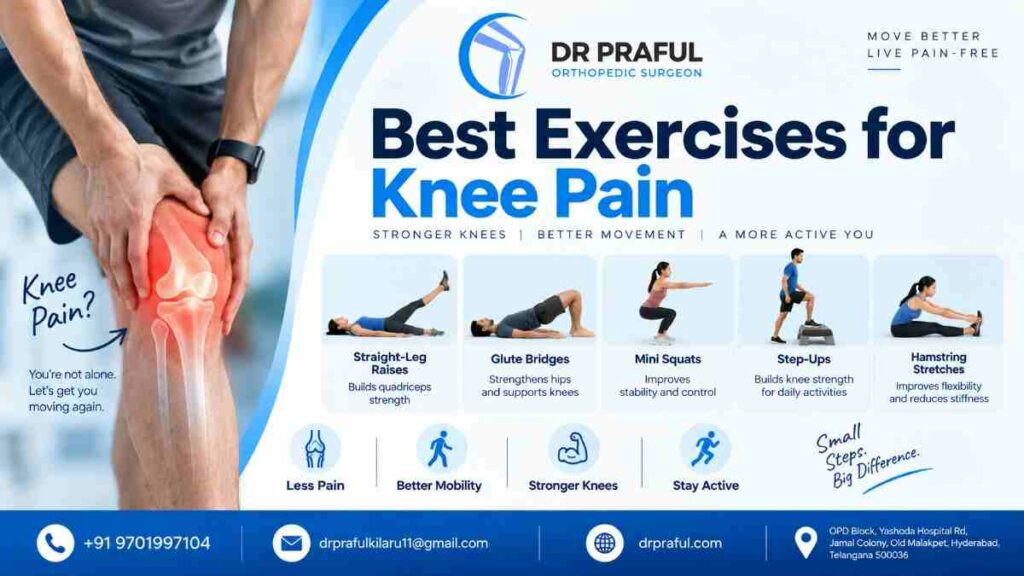
The best exercises for knee pain are usually a combination of gentle mobility exercises, muscle-strengthening exercises and low-impact aerobic activities. However, there is no single exercise that works for everyone. The right routine depends on what is causing your knee pain, how severe your symptoms are, your strength, age and activity level. For many people with non-acute knee problems, exercises that strengthen the quadriceps, hamstrings, hips and glutes can improve support around the knee and make everyday movement easier. Low-impact activities such as walking, cycling and water exercise can also help maintain mobility and fitness without placing excessive stress on the joint.
What Are the Best Exercises for Knee Pain?
If you have mild, non-traumatic knee pain and have no warning signs, a useful exercise program generally includes three components:
- Mobility exercises to maintain comfortable knee movement.
- Strength exercises to improve the muscles supporting the knee.
- Low-impact aerobic exercise to maintain fitness while limiting excessive joint stress.
For people with knee osteoarthritis, exercise is strongly supported as part of conservative management. The AAOS clinical guideline recommends strengthening, low-impact aerobic exercise and neuromuscular education for people with symptomatic knee osteoarthritis.
A 2024 Cochrane review of 139 trials involving 12,468 people found that exercise probably improves pain and physical function in people with knee osteoarthritis, although the authors noted that the clinical importance of the average benefits was uncertain and the studies varied considerably.
So the goal isn’t to find one “magic” exercise.
The goal is to find a routine you can perform safely and consistently.
Why Does Exercise Help Knee Pain?
The knee does not work in isolation.
Your quadriceps, hamstrings, gluteal muscles, hips, calves and core all influence how your lower limb moves and how forces are distributed around the knee.
Weakness or poor movement control can make everyday activities such as:
- Walking
- Climbing stairs
- Getting out of a chair
- Squatting
- Standing for long periods
more difficult.
Strengthening the muscles around the knee can improve stability and help the joint handle everyday movement more effectively. HSS recommends combining strengthening with flexibility and mobility work, while Mayo Clinic notes that strengthening the muscles around the knee can make the joint more stable.
10 Best Exercises for Knee Pain
1. Heel Slides
Heel slides are a gentle mobility exercise that can help maintain or improve comfortable knee movement.
How to do them
- Lie on your back with both legs straight.
- Slowly bend one knee.
- Slide your heel toward your hips.
- Stop when you feel a comfortable stretch or mild resistance.
- Slowly straighten the leg again.
- Repeat on the other side.
Why they may help
Heel slides are particularly useful when the knee feels stiff or movement is limited.
Tip: Do not force the knee into a painful position.
2. Quadriceps Sets
The quadriceps are the large muscles at the front of your thigh and play an important role in knee function.
How to do them
- Sit or lie with your leg comfortably straight.
- Place a small towel under your knee if needed.
- Gently tighten the muscles at the front of your thigh.
- Press the back of your knee gently toward the towel or floor.
- Hold for several seconds.
- Relax and repeat.
This is a useful starting exercise for people who find traditional strengthening movements difficult.
3. Straight-Leg Raises
Straight-leg raises strengthen the quadriceps while keeping the knee relatively straight.
How to do them
- Lie on your back.
- Bend one knee and place that foot flat on the floor.
- Keep the other leg straight.
- Tighten the thigh muscle of the straight leg.
- Slowly raise the leg.
- Pause briefly.
- Lower it slowly.
WebMD and HSS both include straight-leg raises among commonly recommended exercises for knee-related symptoms.
Start slowly
Begin with a small number of controlled repetitions rather than trying to complete a large number immediately.
4. Glute Bridges
Your gluteal muscles help control movement of the hip and lower limb, making them relevant to knee function.
How to do a glute bridge
- Lie on your back.
- Bend your knees.
- Keep your feet comfortably apart.
- Tighten your abdominal and gluteal muscles.
- Slowly lift your hips.
- Hold briefly.
- Lower your hips with control.
WebMD includes glute bridges among exercises that can strengthen the muscles involved in lower-limb movement and support better knee mechanics.
5. Clamshells
Clamshells target the muscles on the outside of the hip, particularly the gluteal muscles that help control the position of the hip and knee.
How to do them
- Lie on your side.
- Bend your knees comfortably.
- Keep your feet together.
- Keep your hips stacked.
- Slowly lift your upper knee.
- Do not rotate your entire body backward.
- Lower the knee slowly.
HSS and WebMD both include hip-focused exercises such as clamshells because muscles around the hip can contribute to lower-limb control.
Progression
Once the movement becomes easy, a resistance band can be added if appropriate.
6. Sit-to-Stand
If getting up from a chair is difficult, sit-to-stand exercises can be a practical way to strengthen the muscles needed for everyday movement.
How to do it
- Sit on a sturdy chair.
- Place your feet comfortably apart.
- Lean forward slightly.
- Push through your feet and stand.
- Slowly lower yourself back into the chair.
- Repeat.
The movement closely resembles a daily activity, which makes it a useful functional exercise.
Make it easier
Use your hands for support initially if necessary.
Make it harder
As strength improves, gradually reduce your reliance on your hands or use a slightly lower chair.
7. Mini Squats
Squats can strengthen the quadriceps, hamstrings and gluteal muscles, but the depth and technique should be appropriate for your knee.
How to perform a mini squat
- Stand with your feet comfortably apart.
- Hold a stable surface if needed.
- Bend your knees slightly.
- Move your hips backward as if sitting down.
- Keep the movement controlled.
- Return to standing.
You do not need to perform deep squats to benefit from strengthening.
Cleveland Clinic notes that deeper squats may aggravate some people with patellofemoral pain, so exercise depth should be adjusted according to symptoms and diagnosis.
8. Step-Ups
Step-ups strengthen the muscles used for walking and climbing stairs.
How to do them
- Stand in front of a low, stable step.
- Place one foot firmly on the step.
- Step up in a controlled manner.
- Bring the other foot up.
- Step down slowly.
- Repeat on the other side.
Start with a low step.
If you have significant knee pain, instability or difficulty controlling the movement, this exercise may need to be modified or supervised.
WebMD includes step-ups among commonly used strengthening exercises for knee pain.
9. Hamstring and Calf Stretches
Tight muscles around the leg can limit comfortable movement.
Useful areas to stretch include:
- Hamstrings
- Quadriceps
- Calves
- Hip flexors
Hamstring stretch
A simple option is to lie on your back, raise one leg while supporting it behind the thigh, and gently straighten the knee until you feel a comfortable stretch.
Calf stretch
Stand facing a wall or sturdy support, place one leg behind you and gently press the back heel toward the floor.
HSS recommends flexibility work alongside strengthening and advises holding stretches without bouncing or pushing into sharp discomfort.
10. Walking, Cycling and Water Exercise
Not every helpful knee exercise needs to be performed on a mat.
Low-impact aerobic activities can help you stay active while placing less impact on painful knees.
Walking
Walking can improve general mobility and fitness, provided it does not significantly worsen your symptoms or cause you to limp.
Cycling
A stationary bicycle can provide a low-impact way to work the legs while moving the knee through a controlled range.
Swimming and Water Exercise
Water reduces the amount of body weight carried through the joints, which can make movement more comfortable for some people.
HSS identifies water exercise, cycling and walking as useful low-impact options for many people with sore knees.
Best Exercises for Different Types of Knee Pain
The most important point about knee exercises is that the cause of the pain matters.
Knee Problem | Exercises Often Used | Important Consideration |
Knee osteoarthritis | Strengthening, walking, cycling, water exercise | Progress gradually |
General weakness | Straight-leg raises, bridges, sit-to-stands | Focus on controlled movement |
Patellofemoral pain | Hip and quadriceps strengthening, mobility | Deep squats may need modification |
Stiff knee | Heel slides, gentle stretching, cycling | Avoid forcing painful movement |
Sports-related pain | Strength, balance and sport-specific rehabilitation | Diagnosis should come first |
After knee surgery | Surgeon/physiotherapist-guided rehabilitation | Follow the prescribed protocol |
Acute swollen knee | Depends on the cause | Get assessed before starting exercises |
This is why copying a generic exercise routine from the internet is not always appropriate.
A Simple Beginner Routine for Knee Pain
If you have mild knee symptoms, no recent significant injury, and no red-flag symptoms, you can think about your exercise routine in three stages.
Stage 1: Mobility
Start with:
- Heel slides
- Gentle hamstring stretching
- Calf stretching
Stage 2: Strength
Progress to:
- Quadriceps sets
- Straight-leg raises
- Glute bridges
- Clamshells
- Sit-to-stands
Stage 3: Functional and aerobic exercise
As your strength improves, consider:
- Mini squats
- Step-ups
- Walking
- Stationary cycling
- Water exercise
This is not a personalized rehabilitation prescription. The appropriate exercises, repetitions and progression depend on the cause of your knee pain.
How Often Should You Exercise for Knee Pain?
There is no single schedule that works for everyone.
HSS recommends strengthening exercises around 2–3 times per week and flexibility work around 3–5 times per week or daily when tolerated.
A practical approach is:
- Begin with a manageable amount.
- Prioritize technique over repetitions.
- Give strengthening sessions adequate recovery.
- Increase difficulty gradually.
- Choose aerobic activities you can perform consistently.
Consistency matters more than trying to complete an intense workout occasionally.
Interestingly, recent research has not established that simply prescribing a larger number of resistance exercises automatically produces better outcomes for knee osteoarthritis. Exercise selection, progression, adherence and individual factors all matter.
How to Exercise Without Making Knee Pain Worse
One of the biggest mistakes people make is assuming that more pain means the exercise is working.
That is not a good rule for knee rehabilitation.
During exercise:
- Mild muscle effort is expected.
- A gentle stretch may be normal.
- Sharp or sudden knee pain is a warning to modify the movement.
- Increasing swelling means you may be doing too much.
- If symptoms remain significantly worse after exercise, reduce the intensity or volume.
- Do not repeatedly push through worsening pain.
WebMD advises starting with fewer repetitions and progressing gradually, while HSS recommends modifying activity when pain persists or worsens.
Exercises to Avoid or Modify When Your Knee Hurts
There is no universal list of exercises that everyone with knee pain must avoid.
However, some movements may need temporary modification depending on the condition.
Be cautious with:
- Deep squats
- Deep lunges
- Jumping
- Running
- High-impact aerobics
- Repetitive stair climbing
- Sudden twisting movements
- Pivoting sports
For example, Cleveland Clinic recommends temporarily avoiding deep squats and lunges in some people with patellofemoral pain because they can increase symptoms.
The important distinction is:
Don’t automatically avoid exercise forever. Modify it according to your diagnosis and current symptoms.
Is Walking Good for Knee Pain?
For many people, yes.
Walking is a low-impact activity that can help maintain strength, mobility and cardiovascular fitness. It is also easy to incorporate into everyday life.
However, walking may not be appropriate at the same intensity if:
- You are limping.
- Your knee is significantly swollen.
- Walking causes increasing pain.
- Your knee repeatedly gives way.
- You recently sustained an injury.
HSS specifically recommends walking as one option for people with sore knees while advising them to reduce intensity or stop when symptoms worsen.
Is Cycling Good for Knee Pain?
Cycling can be a useful low-impact activity for many people with knee pain because it allows controlled knee movement without the repeated impact associated with running.
A stationary bicycle can be particularly useful when starting because resistance and speed can be controlled.
Start gently and increase resistance gradually if your symptoms tolerate it.
Is Swimming Good for Knee Pain?
Swimming and water-based exercise can be useful because water reduces the load placed through the joints.
Water exercise can allow people who find land-based exercise uncomfortable to remain physically active.
HSS lists water aerobics among low-impact activities that can be useful for people with knee pain.
Can Exercise Cure Knee Arthritis?
Exercise does not reverse the structural changes of knee osteoarthritis, but it can help reduce symptoms and improve physical function.
This distinction is important.
The purpose of exercise is to:
- Improve muscle strength
- Maintain mobility
- Improve physical function
- Support daily activities
- Maintain overall fitness
- Help manage pain
The AAOS guideline strongly supports exercise as part of non-surgical management for symptomatic knee osteoarthritis.
When Should You Stop Exercising?
Stop the exercise and seek medical advice if you experience:
- Severe or sudden knee pain
- Significant swelling
- A popping sensation during an injury
- Knee instability
- A locked knee
- Inability to bear weight
- A visibly deformed knee
- Fever with a hot or swollen knee
A particularly important situation is sudden severe knee pain with significant swelling, warmth, redness or fever. This should not be treated as an ordinary exercise-related ache.
When Should You See an Orthopedic Specialist?
Exercise is useful for many causes of knee pain, but it should not replace diagnosis when symptoms are persistent or concerning.
Consider an orthopedic evaluation if:
- Knee pain continues for several weeks.
- Pain repeatedly returns.
- Your knee frequently swells.
- You have difficulty walking or climbing stairs.
- Your knee locks.
- Your knee gives way.
- Pain interferes with sleep or daily activities.
- Symptoms started after a significant injury.
- Home exercises consistently make symptoms worse.
HSS similarly recommends professional evaluation when pain lasts for weeks, follows an injury, interferes with daily activities, or is associated with instability, locking or significant swelling.
For patients with persistent or unexplained knee pain, Dr. Praful’s Knee Pain Treatment in Hyderabad page describes evaluation and both non-surgical and surgical treatment options based on the underlying condition.
Frequently Asked Questions
What is the best exercise for knee pain?
There is no single best exercise for everyone. Strengthening the quadriceps, hips and gluteal muscles, combined with appropriate mobility and low-impact aerobic activity, is commonly used to manage many types of knee pain. The best choice depends on the underlying condition.
Are squats good for knee pain?
Squats can strengthen the muscles supporting the knee, but the depth and technique matter. People with certain conditions, such as patellofemoral pain, may need to temporarily limit deep squats.
Is walking good for painful knees?
Walking can be beneficial for many people with knee pain when it is comfortable and does not cause limping or worsening symptoms. Start with shorter distances and gradually increase activity as tolerated.
Is cycling better than walking for knee pain?
Neither is universally better. Cycling may be more comfortable for some people because it is low-impact and provides controlled knee movement, while walking is easier to incorporate into daily life.
Can exercise make knee pain worse?
Yes. Exercising with inappropriate intensity, poor technique or an unsuitable exercise for your condition can aggravate symptoms. Persistent increases in pain or swelling are signals to modify the program and seek professional advice.
How often should I exercise with knee pain?
It depends on your condition and exercise type. HSS suggests strengthening around two to three times per week and flexibility work three to five times weekly or daily when tolerated.
Should I exercise if my knee is swollen?
A swollen knee should not automatically be exercised through. The cause of the swelling matters. If swelling is significant, sudden or associated with severe pain, warmth, redness or fever, seek medical evaluation before starting or continuing an exercise program.
Are knee exercises good for osteoarthritis?
Yes. Exercise is a core part of non-surgical management for symptomatic knee osteoarthritis. AAOS strongly recommends strengthening and low-impact aerobic exercise as part of treatment.
Can knee exercises prevent knee replacement?
Exercise can improve strength, mobility and function, but it cannot guarantee that surgery will never be necessary. Advanced joint damage may eventually require surgical treatment despite appropriate conservative care.
What should I do if knee exercises hurt?
Stop or modify the movement if it causes sharp or increasing pain. If symptoms continue to worsen or the knee becomes swollen, unstable or difficult to use, consult an orthopedic specialist or physiotherapist.
Key Takeaways
- The best exercises for knee pain depend on the cause of the pain.
- Strengthening the quadriceps, hamstrings, hips and glutes can improve support and function around the knee.
- Mobility exercises can help maintain comfortable movement.
- Walking, cycling and water exercise are useful low-impact options for many people.
- Exercise is strongly recommended as part of conservative treatment for knee osteoarthritis.
- You do not need to perform dozens of exercises. A small, consistent and appropriately progressed program can be more practical.
- Do not ignore significant swelling, instability, locking, inability to bear weight, or severe pain.
- If your knee pain has not been diagnosed, identifying the cause should come before choosing an intensive exercise program.
Conclusion
The best exercises for knee pain are not necessarily the hardest exercises or the ones that produce the most muscle soreness. For most people, the goal is to gradually improve strength, mobility, balance and overall fitness without repeatedly aggravating the knee.
A practical program may combine simple exercises such as quadriceps sets, straight-leg raises, bridges, clamshells and sit-to-stands with appropriate stretching and low-impact activities such as walking, cycling or water exercise.
But exercise should be matched to the problem. A person with knee osteoarthritis may benefit from a progressive strengthening and aerobic program, while someone with an ACL tear, meniscus injury, significant swelling or recent surgery may require a very different rehabilitation plan.
If your knee pain is persistent, recurrent, associated with swelling or instability, or affecting your daily life, don’t rely on a generic exercise list alone. An orthopedic assessment can identify the underlying problem and help determine which exercises are appropriate for your knee.
Consultation CTA
Persistent Knee Pain? Find Out What Is Causing It.
If knee pain is affecting your walking, stairs, exercise or daily activities, an accurate diagnosis is the first step toward choosing the right treatment.
Dr. Praful Kilaru provides orthopedic evaluation and personalized treatment for knee pain, arthritis, sports injuries, ligament problems and other knee conditions in Hyderabad. His practice includes non-surgical approaches such as physiotherapy, rehabilitation, activity modification and injections, with surgery considered when clinically appropriate.
Book an orthopedic consultation with Dr. Praful in Malakpet, Hyderabad.