
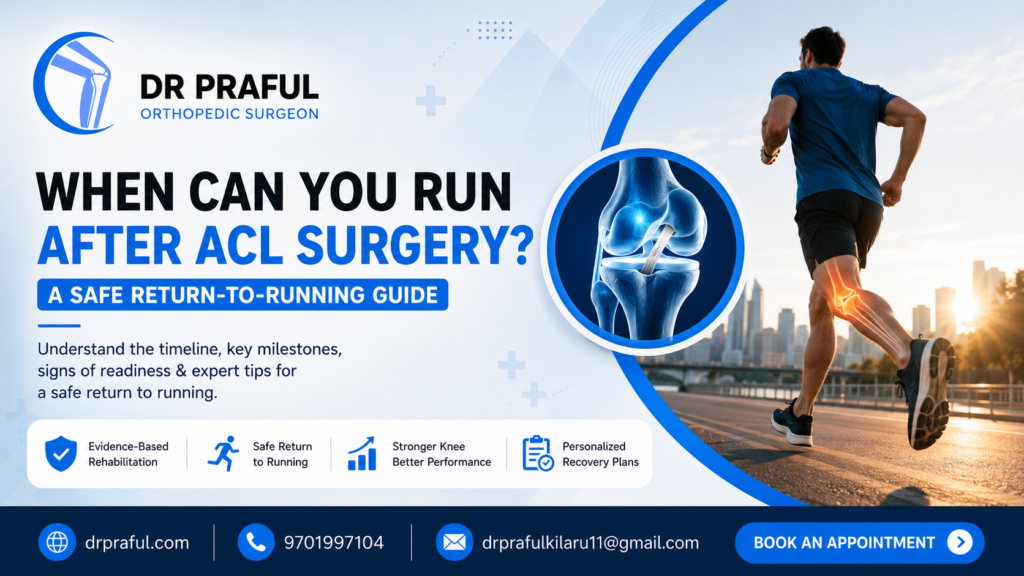
When Can You Run After ACL Surgery? A Safe Return-to-Running Guide

Dr.Praful Kilaru
Medically reviewed by Dr. Praful Kilaru, MBBS, MS (Orthopaedics), AO Trauma Fellowship, Davos, Switzerland
Senior Orthopedic Consultant, Yashoda Hospitals, Malakpet, Hyderabad
Experience: 18+ years | 1,400+ surgeries
Last medically reviewed: August 2026
When Is It Safe to Run After ACL Surgery?
Most people should not start running simply because a certain number of weeks have passed after ACL reconstruction. In many rehabilitation protocols, a gradual running program may begin around 3–5 months after surgery, but the exact timing depends on your knee strength, movement, swelling, stability and functional testing. Massachusetts General Brigham’s ACL rehabilitation protocol, for example, introduces interval running during the 3–5 month phase when appropriate criteria have been achieved.
So, the more important question is not simply, “When can I run again?”
It is:
“Is my knee ready to handle running?”
That difference matters because running too early can overload a recovering knee, while waiting for the right strength and movement milestones can make the return safer.
Why Is Running Different From Walking After ACL Surgery?
Walking and running do not place the same demands on your knee.
Walking can often be reintroduced relatively early during ACL rehabilitation. Running requires much more force, repeated impact, single-leg control and coordination.
When you run, your operated leg has to repeatedly:
- Accept your body weight
- Absorb force
- Stabilize the knee
- Control the hip and ankle
- Push your body forward
- Maintain alignment during repeated single-leg movements
Your ACL graft may be healing well, but that does not automatically mean your muscles and movement control are ready for running.
This is why ACL rehabilitation should progress through strength, balance, neuromuscular control and functional activities, rather than following the calendar alone.
What Is the Typical Running Timeline After ACL Surgery?
There is no single running date that applies to everyone.
A broad rehabilitation pathway may look like this:
First 6 weeks: Restore the basics
The early focus is usually on:
- Controlling pain and swelling
- Restoring knee movement
- Regaining full extension
- Activating the quadriceps
- Improving walking
- Gradually rebuilding strength
Running is generally not the goal at this stage.
Weeks 6–12: Build Strength and Improve Knee Stability
Rehabilitation progresses toward:
- Stronger quadriceps
- Stronger hamstrings
- Hip and core strengthening
- Better balance
- Improved single-leg control
- Normal walking mechanics
The exact exercises depend on your surgery and rehabilitation plan.
Months 3–5: Moving Toward Running and Higher-Level Activities
Some patients may begin an interval jogging/running program during this stage if they meet the required criteria.
For example, the Mass General Brigham protocol places interval running in the 3–5 month phase and requires appropriate strength, functional testing and absence of pain or swelling before progressing.
6+ Months: Preparing for a Full Return to Sports
At this stage, rehabilitation may progress toward:
- Running faster
- Changing direction
- Jumping and landing
- Agility exercises
- Sport-specific movements
But being able to jog does not automatically mean you are ready for football, cricket, basketball or other pivoting sports.
9–12 months or longer: Return to demanding sports
Return to competitive or pivoting sports often requires substantially more rehabilitation than simply returning to straight-line jogging.
AAOS emphasizes that return-to-sport decisions should consider factors such as objective and subjective knee stability, functional strength and limb symmetry, rather than time alone.
7 Important Signs You’re Ready to Start Running After ACL Surgery
Before starting a running program, your orthopedic surgeon or physiotherapist may assess several factors.
1. Your knee has good range of motion
You should be able to move your knee sufficiently without significant stiffness interfering with your running mechanics.
2. Swelling is under control
Running on a knee that repeatedly becomes swollen after exercise is a warning sign.
Mass General’s protocol specifically recommends progressing only when running can be completed without pain or effusion/swelling.
3. Your quadriceps are strong enough
Quadriceps weakness is common after ACL reconstruction.
You need adequate strength to control the knee when your foot strikes the ground.
4. Your hamstrings and hip muscles are functioning well
Running is not just a knee activity.
Your hip, thigh, knee and ankle work together to absorb and produce force.
5. You can control your operated leg
You should be able to perform appropriate single-leg movements without the knee collapsing inward or losing balance.
6. You have no episodes of instability
A knee that gives way is not ready to be pushed into running simply because the calendar says three months have passed.
7. Functional testing is satisfactory
Strength and hop testing may be used as part of the return-to-sport decision.
AAOS notes that functional evaluations such as hop testing may be considered when determining readiness for return to sport after ACL reconstruction.
Why Your Recovery Timeline Matters More Than the Calendar
Two patients can have ACL surgery on the same day and still have very different recovery timelines.
One may have:
- Excellent strength
- Minimal swelling
- Full movement
- Good balance
- Normal running mechanics
Another may still have:
- Quadriceps weakness
- Reduced knee movement
- Swelling after exercise
- Poor single-leg control
- Pain during loading
Giving both patients the same running date would make little sense.
ACL rehabilitation should be milestone-based, not just date-based.
This is one of the most important things patients should understand after ACL reconstruction.
What Happens If You Start Running Too Early?
Starting too soon can cause problems even if the knee initially feels comfortable.
Possible issues include:
- Increased swelling
- Knee pain
- Poor running mechanics
- Muscle overload
- Loss of confidence
- Compensatory movement patterns
- Increased stress on the recovering knee
It does not mean that running at exactly three months will automatically damage your graft.
It means that your readiness matters more than a number on the calendar.
How Should You Start Running After ACL Surgery?
Your first run should not be a test of how fast you can go.
A gradual return is usually more appropriate.
A rehabilitation professional may begin with an interval format such as:
Walk → easy jog → walk → easy jog
As your knee tolerates the workload, running time can gradually increase.
The progression should be controlled rather than based on how excited you feel on your first pain-free day.
A simple rule to remember
No significant pain. No increasing swelling. Good movement. Good control. Gradual progression.
If your knee becomes painful or swollen after increasing running, your rehabilitation team may need to modify the workload.
What Should You Do If Your Knee Swells After Running?
Do not simply push through repeated swelling.
Swelling after running can mean that the current workload is too high, although the cause can vary.
Your doctor or physiotherapist may assess:
- Running volume
- Running technique
- Muscle strength
- Knee movement
- Joint stability
- Other structures inside the knee
The appropriate response is to identify the reason rather than assuming that every episode of swelling is normal.
Running Is Not the Same as Returning to Sport
This distinction is often missed.
You may be able to run in a straight line but still not be ready to play:
- Football
- Cricket
- Basketball
- Badminton
- Tennis
- Kabaddi
- Volleyball
These sports involve acceleration, deceleration, jumping, landing, cutting and sudden changes of direction.
The knee therefore needs a higher level of strength and neuromuscular control.
Mass General’s rehabilitation protocol progresses from running toward plyometrics, agility and sport-specific training before unrestricted sports.
When Is ACL Surgery Required?
Not every ACL tear automatically requires reconstruction.
Treatment depends on factors such as:
- Age
- Activity level
- Knee stability
- Associated meniscus or cartilage injuries
- Desired sports
- Response to rehabilitation
- Degree of functional limitation
ACL reconstruction may be considered particularly when a patient has persistent instability or wants to return to sports involving repeated cutting and pivoting.
AAOS notes that reconstruction can be considered in selected patients to help reduce the risk of future meniscus pathology or procedures, particularly in younger or more active individuals.
If you have recently injured your knee, an orthopedic evaluation can help determine whether rehabilitation alone or surgery is more appropriate.
ACL Tear Symptoms: What Should You Look For?
An ACL injury commonly occurs during a sudden change in direction, awkward landing or sports-related movement.
Symptoms can include:
- A sudden popping sensation
- Rapid knee swelling
- Knee pain
- Difficulty continuing activity
- Reduced knee movement
- A feeling that the knee is unstable
- Difficulty putting full weight on the leg
Not every knee injury with these symptoms is an ACL tear.
Other structures, including the meniscus and other ligaments, can also be injured.
What Causes an ACL Tear?
The ACL can tear when forces on the knee exceed the ligament’s ability to tolerate them.
Common situations include:
Sudden direction changes
Changing direction rapidly while the foot is planted can place substantial stress on the ACL.
Awkward landing
Poor landing mechanics after a jump can contribute to ACL injury.
Sudden stopping
Rapid deceleration during sport can increase knee loading.
Contact injuries
A direct blow can force the knee into an abnormal position.
Sports such as football, basketball, cricket and other activities involving cutting, pivoting and jumping can carry a higher ACL injury risk.
How Is an ACL Tear Diagnosed?
Diagnosis usually begins with a clinical examination.
Your orthopedic surgeon may assess:
- Knee swelling
- Range of motion
- Stability
- Lachman test
- Pivot-shift findings
- Associated injuries
An MRI may be recommended when the diagnosis is uncertain or when additional injuries such as meniscus or cartilage damage need evaluation.
The diagnosis should not be based on an MRI report alone.
Your symptoms, examination and imaging findings need to be considered together.
Red Flags After ACL Surgery
Contact your orthopedic team if you experience concerning symptoms during recovery, including:
- Increasing rather than improving knee swelling
- Significant or worsening pain
- Repeated episodes of the knee giving way
- Fever with increasing knee redness or wound problems
- New calf swelling or significant calf pain
- Sudden inability to bear weight
- New locking of the knee
- A sudden popping sensation followed by instability
These symptoms do not automatically mean that the ACL graft has failed.
But they deserve assessment rather than being ignored.
Treatment Options for an ACL Tear
Treatment can broadly include:
Non-surgical rehabilitation
Some patients may be managed with structured physiotherapy, strengthening and activity modification.
This may be appropriate depending on knee stability, lifestyle and sporting goals.
ACL reconstruction
During ACL reconstruction, the damaged ligament is replaced with a healthy tendon graft.
The choice of graft and surgical approach depends on the individual patient.
Rehabilitation
ACL rehabilitation is important for recovery, regardless of whether surgery is needed.
It aims to restore:
- Range of motion
- Strength
- Balance
- Coordination
- Neuromuscular control
- Functional confidence
Mass General notes that ACL rehabilitation can extend to around a year as patients progressively rebuild strength, agility and sports-specific ability.
Recovery After ACL Surgery: What Should You Expect?
ACL recovery is a process rather than a single milestone.
Early stage
The priority is controlling swelling and pain while restoring knee movement.
Strength stage
The focus shifts toward rebuilding the quadriceps, hamstrings, hips and core.
Control stage
Balance, coordination and single-leg control become increasingly important.
Running stage
Running is introduced gradually when appropriate criteria have been met.
Sports stage
Plyometrics, agility, cutting and sport-specific drills are introduced progressively.
Return-to-sport stage
The final decision should consider strength, movement quality, stability, functional testing and psychological readiness — not simply the number of months since surgery.
AAOS’s appropriate-use criteria for return to pre-injury activity specifically considers time since surgery alongside stability, functional strength and limb symmetry.
How Can You Reduce the Risk of Another ACL Injury?
Returning to your previous activity is only part of successful ACL rehabilitation.
You also want to return with better control.
Important areas include:
- Quadriceps and hamstring strength
- Hip strength
- Core control
- Landing technique
- Balance
- Deceleration mechanics
- Cutting technique
- Gradual training progression
Sports-specific neuromuscular training can help address movement patterns associated with ACL injury risk. AAOS also highlights lower-extremity strength and landing mechanics as important components of injury prevention.
ACL Surgery and Recovery in Hyderabad
For patients in Hyderabad, the goal of ACL treatment should not simply be “surgery completed.”
A successful outcome also involves restoring the knee’s strength and function so that you can safely return to your daily activities, exercise or sport.
Dr. Praful Kilaru is presented as a Senior Orthopedic Consultant at Yashoda Hospitals, Malakpet, Hyderabad, with MBBS, MS (Orthopaedics), AO Trauma Fellowship from Davos, Switzerland and 18+ years of experience.
The appropriate treatment depends on the individual injury, associated damage, activity level and recovery goals.
For patients looking for orthopedic evaluation in Hyderabad, an assessment can help determine the next step rather than relying on a generic recovery timeline.
- ACL Reconstruction
- Sports Injury Treatment
- Knee Arthroscopy
- Knee Pain Treatment
Frequently Asked Questions
Can I run 3 months after ACL surgery?
Some patients may begin a gradual running program around the 3–5 month stage, but three months is not an automatic clearance date. Strength, swelling, movement, stability and functional testing should be considered first.
Can I run 6 months after ACL surgery?
Some patients can run comfortably by six months, but readiness varies. Being able to run does not necessarily mean that you are ready for cutting, pivoting or competitive sport.
Why can’t I run after ACL surgery if I have no pain?
Pain is only one part of recovery. You may still have weakness, poor single-leg control or inadequate neuromuscular coordination even if the knee feels comfortable.
How do I know if my ACL graft is strong enough for running?
Your surgeon or rehabilitation professional can assess knee stability, strength, movement quality and functional performance. There is no reliable home test that can independently confirm graft readiness.
Is jogging safer than running after ACL surgery?
Jogging at a controlled pace may be used as an early step in a gradual return-to-running program, but safety depends on your rehabilitation stage and knee readiness rather than the label “jogging.”
Can I run after ACL surgery without physiotherapy?
It is not advisable to decide on running progression without appropriate rehabilitation guidance. ACL recovery requires progressive strength, movement and functional training.
When can I play football after ACL reconstruction?
Football requires more than straight-line running because it involves cutting, pivoting, acceleration and deceleration. Return should occur only after appropriate rehabilitation and return-to-sport testing.
What if my knee swells after jogging?
Stop increasing the workload and discuss the swelling with your rehabilitation team or orthopedic surgeon. Repeated swelling should be assessed rather than repeatedly pushed through.
Does ACL surgery guarantee that I can return to sports?
No surgery can guarantee a specific sports outcome. Successful return depends on healing, rehabilitation, strength, movement quality, confidence and the demands of the sport.
Is ACL reconstruction necessary for every athlete?
No. Treatment is individualized. Some patients can function well with rehabilitation, while others with instability or high-demand sporting goals may benefit from reconstruction.
The Bottom Line: Don't Race the Calendar
If you remember only one thing from this article, remember this:
You should return to running when your knee is ready — not simply when you reach a particular number of months after ACL surgery.
For some patients, running may begin around 3–5 months as part of a structured rehabilitation program. Others may need more time.
The real milestones are:
Full or appropriate knee movement → minimal swelling → adequate strength → good single-leg control → functional testing → gradual running progression.
And running is only one step.
If your goal is to return to football, cricket, basketball, badminton or another pivoting sport, you will need additional strength, agility, jumping, landing and sport-specific training before full return.
If you have had ACL surgery and are unsure whether your knee is ready to run, an orthopedic assessment can help you understand where you are in the recovery process and what the next milestone should be.
Don’t rush the return. Build the knee that can handle the return.
Considering ACL treatment in Hyderabad?
Book an orthopedic consultation with Dr. Praful to discuss your knee injury, treatment options and rehabilitation goals.
Medical References
- American Academy of Orthopaedic Surgeons (AAOS) — Clinical Guidelines for ACL Injury Treatment
- American Academy of Orthopaedic Surgeons (AAOS) — Appropriate Use Criteria: Return to Play to Pre-Injury Level Following ACL Injury.
- Mass General Brigham — Rehabilitation Protocol for Anterior Cruciate Ligament Reconstruction
- Massachusetts General Hospital — ACL Injury Symptoms, Diagnosis, and Treatment
- American Academy of Orthopaedic Surgeons (AAOS) — ACL Injury Prevention and Return-to-Sport Considerations.
Medical Disclaimer
This article is intended for general educational purposes and does not replace an individual examination or medical consultation. ACL recovery varies according to the type of injury, surgical procedure, graft, associated injuries, rehabilitation progress and individual health. Do not begin running or return to sport without clearance from your orthopedic surgeon or rehabilitation professional.