Can an ACL Tear Heal on Its Own?
Dr.Praful Kilaru
Medically reviewed by Dr. Praful Kilaru, MBBS, MS (Orthopaedics), AO Trauma Fellowship, Davos, Switzerland
Senior Orthopedic Consultant, Yashoda Hospitals, Malakpet, Hyderabad
Experience: 18+ years | 1,400+ surgeries
Last medically reviewed: August 2026
Complete Guide to ACL Recovery
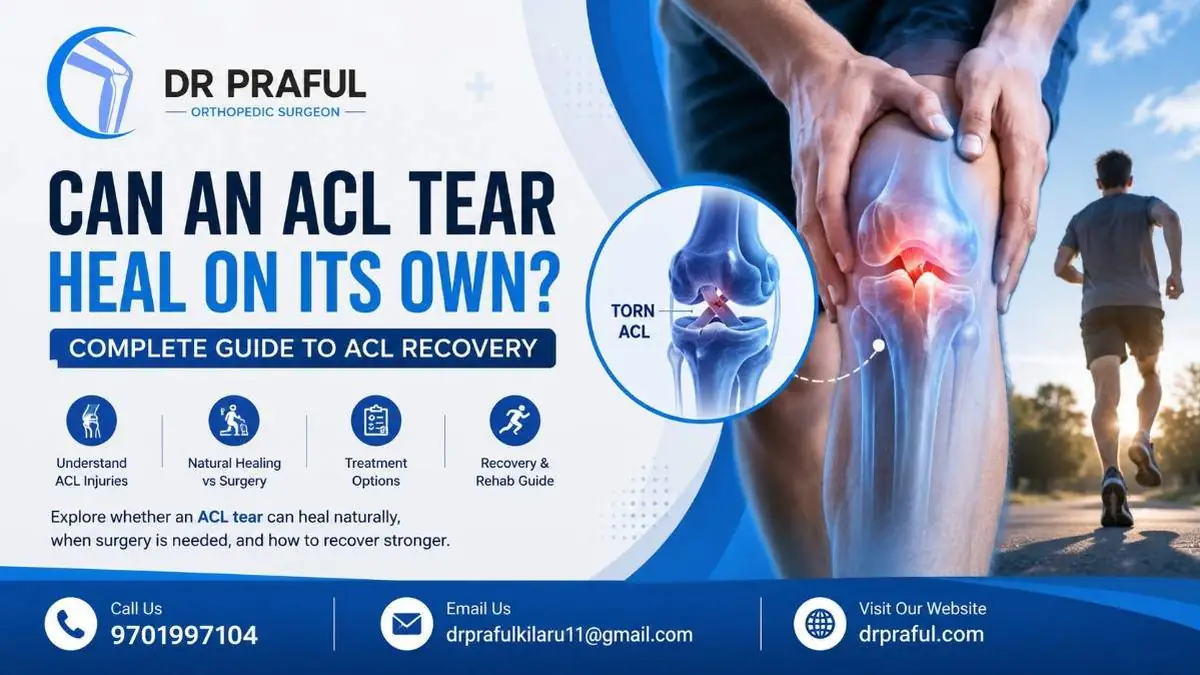
Can an ACL tear heal on its own? Sometimes, a person with an ACL injury can recover good knee function without surgery, but this does not mean every torn ACL grows back normally.
The answer depends on whether the ACL is stretched, partially torn, or completely torn, how stable the knee is, the person’s age and activity level, and whether other parts of the knee are injured.
A partial ACL tear may sometimes be managed without surgery through careful rehabilitation. A complete ACL tear is less likely to provide a stable knee without reconstruction, especially in people who want to return to sports that involve running, jumping, twisting, or sudden changes of direction.
Can an ACL Tear Heal Without Surgery?
A partial ACL tear may sometimes be treated without surgery, but a complete ACL tear usually does not simply heal back to its original strength and structure.
Some people with an ACL tear can live normally without reconstruction if their knee remains stable and they do not take part in activities that require a lot of twisting or pivoting.
However, if the knee repeatedly gives way, feels unstable, or the person wants to return to high-demand sports, surgery may be considered.
The decision should be made after an orthopedic examination and, when needed, imaging such as an MRI.
What Is the ACL?
ACL stands for anterior cruciate ligament.
It is a strong band of tissue inside the knee. It connects the thigh bone, called the femur, to the shin bone, called the tibia.
Think of the ACL as one of the knee’s important stabilizing ropes.
It helps control the knee when you:
- Walk
- Run
- Jump
- Stop suddenly
- Change direction
- Land after jumping
- Turn your body while your foot is on the ground
This is why ACL injuries are common in sports such as football, cricket, basketball, badminton, and other activities involving sudden turning or landing.
What Happens When the ACL Tears?
An ACL injury can vary from a minor ligament stretch to a partial or complete tear.
Doctors generally describe ACL injuries in three grades.
Grade 1 ACL Injury
The ligament is stretched but remains intact.
The knee is usually stable.
This type of injury may recover with appropriate rest and rehabilitation.
Grade 2 ACL Injury
The ligament is partially torn and becomes looser.
This is commonly called a partial ACL tear.
Some people with partial tears can recover good knee function through structured rehabilitation, especially if the knee does not feel unstable.
Grade 3 ACL Injury
The ACL is completely torn or separated from its attachment.
This is commonly called a complete ACL tear.
The knee may become unstable, particularly during twisting, pivoting, jumping, or sports.
AAOS notes that partial ACL tears can sometimes be treated without surgery, while complete tears have a less favorable outcome with non-operative treatment when instability is present.
Can a Partial ACL Tear Heal on Its Own?
A partial ACL tear may improve without surgery, but it still needs proper assessment.
Treatment may include:
- Activity modification
- Physiotherapy
- Strengthening exercises
- Balance and coordination training
- Gradual return to normal activities
- Sometimes a knee brace
The goal is not simply to wait for the ligament to heal.
The goal is to make the knee strong, stable, and functional.
AAOS states that partial ACL tears may be treated non-operatively with progressive physical therapy and rehabilitation. Recovery commonly requires at least several months, and some people can still have instability because the ligament remains loose.
Can a Complete ACL Tear Heal Naturally Without Surgery?
A complete ACL tear is different.
The torn ACL generally has limited ability to heal itself inside the knee because of its location and blood supply.
Some people with complete ACL tears can still function without reconstruction, particularly if they have low activity demands and do not experience instability.
However, a person who wants to return to sports involving:
- Cutting
- Pivoting
- Jumping
- Sudden stopping
- Rapid changes in direction
may have difficulty if the knee remains unstable.
Therefore, “I can walk without pain” does not necessarily mean the ACL has healed.
The knee may feel fine during simple activities but become unstable during running or turning.
Does Every ACL Tear Require Surgery, or Can It Heal Without It?
No. An ACL tear does not automatically mean surgery.
Both surgical and non-surgical treatment can be appropriate depending on the individual situation.
Doctors consider:
- Type of ACL tear
- Knee stability
- Age
- Activity level
- Sports participation
- Work requirements
- Other knee injuries
- Patient goals
- Response to rehabilitation
International ACL treatment consensus also supports non-operative treatment for selected patients, particularly those whose goals involve straight-line activities and who do not have persistent instability.
When Can an ACL Tear Heal Without Surgery?
Non-surgical treatment may be considered when:
- The tear is partial.
- The knee remains stable.
- The person has few or no giving-way episodes.
- The person does not participate in high-risk pivoting sports.
- The person’s work does not require heavy knee twisting.
- The patient improves with structured rehabilitation.
- There are no major associated injuries requiring surgery.
For example, someone who mainly walks, cycles, swims, or performs other controlled activities may sometimes function well without ACL reconstruction if the knee remains stable.
However, this decision should be made after proper evaluation.
When Is ACL Surgery Usually Recommended for an ACL Tear?
ACL reconstruction may be considered when:
- The ACL is completely torn.
- The knee repeatedly gives way.
- The person wants to return to pivoting or cutting sports.
- Rehabilitation does not restore sufficient stability.
- There are associated meniscus or cartilage injuries.
- The person has a physically demanding job.
- The knee remains unstable during daily activities.
Persistent instability is particularly important.
Repeated giving-way episodes can place additional stress on other structures inside the knee, including the meniscus and cartilage.
What Are the Symptoms of an ACL Tear?
Common symptoms include:
1. A Sudden Popping Feeling
Some people feel or hear a “pop” when the injury happens.
2. Knee Swelling
The knee may swell soon after the injury.
3. Pain
Pain may occur around the knee, especially after the injury.
4. Difficulty Walking
Walking may become uncomfortable or difficult.
5. Knee Instability
The knee may feel as if it is going to give way.
6. Reduced Movement
The knee may become difficult to fully bend or straighten.
7. Difficulty Returning to Sports
Running, jumping, turning, and sudden stopping may become difficult.
Not everyone experiences all these symptoms.
How Does an ACL Tear Usually Happen?
An ACL tear often happens when the knee suddenly changes direction.
Common causes include:
- Landing awkwardly after a jump
- Suddenly stopping while running
- Twisting the knee
- Changing direction quickly
- Sports collisions
- Falls
- Road traffic accidents
- Direct impact to the knee
Sports such as football, cricket, basketball, badminton, and skiing can place high demands on the ACL.
Can You Walk With a Torn ACL?
Yes, many people can walk with a torn ACL.
Being able to walk does not necessarily mean that the ACL is uninjured.
A person may be able to walk reasonably well but still experience instability while:
- Running
- Going downstairs
- Turning quickly
- Jumping
- Playing sports
- Walking on uneven ground
This is why an orthopedic assessment is important after a significant knee injury.
Can an ACL Tear Get Better Without Surgery?
Yes, knee function can improve without surgery in selected patients.
However, feeling better does not always mean that the torn ACL has completely healed.
A person may regain:
- Muscle strength
- Knee movement
- Balance
- Confidence
- Walking ability
- Functional stability
through rehabilitation.
The damaged ACL itself may still remain partially or completely deficient.
This distinction is important when deciding whether surgery is necessary.
What Is Non-Surgical Treatment for an ACL Tear?
Non-surgical treatment usually focuses on restoring knee function.
1. Physiotherapy
A physiotherapist may design exercises to improve:
- Quadriceps strength
- Hamstring strength
- Hip strength
- Balance
- Coordination
- Knee movement
2. Activity Modification
You may need to temporarily avoid movements that make the knee unstable.
This can include jumping, pivoting, or sudden direction changes.
3. Knee Support
A doctor may recommend a brace for selected patients.
A brace does not repair a completely torn ACL, but it may provide support in certain situations.
4. Pain and Swelling Management
Your doctor may recommend appropriate measures to control pain and swelling.
5. Progressive Rehabilitation
Exercises should gradually become more challenging as knee strength and control improve.
The aim is to return to normal activity safely rather than rushing back to sports.
How Long Does an ACL Tear Take to Recover Without Surgery?
There is no single recovery time for every ACL injury.
Recovery depends on:
- Partial or complete tear
- Knee stability
- Other injuries
- Muscle strength
- Age
- Activity level
- Rehabilitation
- Individual recovery
For partial ACL injuries treated without surgery, rehabilitation may take at least several months.
AAOS notes that non-operative treatment for partial ACL tears can require at least three months of rehabilitation.
A longer rehabilitation period may be needed before returning to demanding sports.
Can Physiotherapy Heal a Torn ACL?
Physiotherapy can help the knee become stronger and more stable, but it does not magically reconnect a completely torn ACL.
This is an important difference.
Physiotherapy can improve:
- Muscle strength
- Balance
- Knee control
- Flexibility
- Movement
- Confidence
- Ability to perform daily activities
Some patients can function well without ACL reconstruction after structured rehabilitation.
However, if the knee continues to give way, further treatment may be necessary.
What Happens If an ACL Tear Is Left Untreated?
An ACL tear should not simply be ignored.
If the knee remains unstable, repeated giving-way episodes may increase the chance of injury to other structures.
These may include:
- Meniscus
- Cartilage
- Other knee ligaments
AAOS reports that chronic knee instability is associated with a greater risk of meniscal injury over time.
This does not mean every untreated ACL tear will cause arthritis or another injury.
It means that persistent instability deserves medical attention.
Can You Play Sports With a Torn ACL?
It depends on the sport and the stability of the knee.
Straight-line activities may be possible for some people after appropriate rehabilitation.
Sports involving frequent:
- Pivoting
- Cutting
- Jumping
- Sudden stopping
- Direction changes
put greater demands on the ACL.
If your knee repeatedly gives way, returning to these sports without proper treatment may increase the risk of additional knee injury.
The ACL consensus literature supports non-operative management for selected patients but recommends considering reconstruction when instability persists in the desired activity.
Can You Exercise With an ACL Tear?
Exercise may be part of treatment, but the exercises should match the injury.
Early rehabilitation may focus on:
- Regaining knee movement
- Reducing swelling
- Activating the quadriceps
- Improving leg strength
- Improving balance
Later exercises may become more challenging.
Do not copy a random ACL exercise program from the internet and assume it is safe for your injury.
A physiotherapist or orthopedic specialist should guide the rehabilitation plan.
Does an ACL Tear Need an MRI?
An MRI can provide detailed information about the ACL and other soft tissues inside the knee.
It can help doctors identify:
- ACL damage
- Meniscus tears
- Cartilage injuries
- Other ligament injuries
AAOS notes that MRI is particularly useful for identifying associated soft-tissue injuries and assessing the severity of an ACL injury.
Your doctor will decide whether MRI is appropriate based on your symptoms and physical examination.
How Is an ACL Tear Diagnosed?
Diagnosis usually begins with a medical history and physical examination.
Your doctor may ask:
- How did the injury happen?
- Did you hear or feel a pop?
- Did swelling develop quickly?
- Does the knee give way?
- Can you fully bend and straighten the knee?
- Do you play sports?
The doctor may perform specific knee stability tests.
Imaging such as MRI may then be used when appropriate.
Partial ACL Tear vs Complete ACL Tear
Feature | Partial ACL Tear | Complete ACL Tear |
Ligament damage | Part of ACL is torn | ACL is completely torn |
Knee stability | May remain stable | Often less stable |
Surgery | Not always required | More likely if instability is present |
Rehabilitation | Often important | Important whether or not surgery is performed |
Return to pivoting sports | Depends on stability | Often more difficult without reconstruction |
Treatment | Individualized | Individualized |
The most important factor is not simply the MRI wording.
How stable and functional is the knee?
Can an ACL Tear Heal Naturally With Rest Alone?
Rest can help reduce pain and swelling, but rest alone is usually not enough to restore knee strength and control after an ACL injury.
The knee may need structured rehabilitation.
Think of it like this:
Rest calms the injury.
Rehabilitation trains the knee.
Medical evaluation determines whether more treatment is needed.
What Should You Do Immediately After Suspecting an ACL Injury?
If you injure your knee and suspect an ACL tear:
- Stop the activity.
- Avoid movements that increase pain or instability.
- Protect the knee from further injury.
- Follow appropriate measures recommended by a healthcare professional for swelling and pain.
- Arrange an orthopedic evaluation.
- Do not return to sports until your knee has been properly assessed.
Do not try to “test” the knee by repeatedly twisting it.
When Should You See an Orthopedic Doctor?
You should consider medical evaluation if you have:
- Significant knee swelling
- Severe knee pain
- Difficulty putting weight on the leg
- A popping sensation during injury
- Repeated knee instability
- Difficulty fully moving the knee
- Persistent symptoms after a sports injury
- A sensation that the knee is unstable or may suddenly give way
Early evaluation can help identify ACL and associated injuries and guide the right treatment.
Does Every ACL Tear Require ACL Reconstruction?
No.
ACL reconstruction is not automatically required for every ACL injury.
The decision should be personalized.
For example:
A person with a partial ACL tear and a stable knee may improve with rehabilitation.
A person with a complete ACL tear who does not participate in pivoting sports and has no instability may sometimes choose non-operative management.
A competitive athlete with repeated instability may be more likely to benefit from reconstruction.
This is why the treatment decision should be based on the person, the knee, and the person’s goals, not just the MRI report.
What Is ACL Reconstruction?
ACL reconstruction is a surgical procedure used to restore knee stability by replacing the damaged ACL with a graft.
It is different from simply stitching every torn ACL back together.
The graft may come from a patient’s own tendon or, in selected cases, donor tissue.
ACL reconstruction is commonly performed using minimally invasive arthroscopic surgery.
Your orthopedic surgeon will decide which technique and graft are appropriate for your specific injury.
What Is the Difference Between ACL Repair and ACL Reconstruction?
ACL repair attempts to preserve and reattach the patient’s original ligament.
ACL reconstruction repairs the knee by replacing the damaged ACL with a strong tissue graft.
Reconstruction remains the more common surgical approach.
AAOS notes that ACL repair may be suitable for selected injuries, such as some tears close to the ligament’s attachment or certain partial tears, but reconstruction remains the standard surgical treatment for many ACL injuries.
Can an ACL Tear Heal Without Surgery in a Young Person?
Age alone does not decide treatment.
A young person who wants to return to football, cricket, basketball, badminton, or another pivoting sport may have different treatment needs from a young person whose activities are mostly walking or cycling.
Children and teenagers also require special consideration because their bones may still be growing.
Therefore, a young athlete with an ACL injury should be evaluated by an orthopedic specialist familiar with sports injuries and, when relevant, pediatric ACL care.
Can an ACL Tear Heal Without Surgery in Older Adults?
Some older adults with ACL tears can function without reconstruction, especially if they have low physical demands and a stable knee.
Treatment may focus on:
- Strengthening
- Balance
- Activity modification
- Pain control
- Functional rehabilitation
However, age should not be used as the only reason to avoid surgery.
Overall health, activity goals, knee stability, and associated injuries also matter.
7 Signs That Your ACL Injury May Need Further Evaluation
Watch for these warning signs:
- Your knee repeatedly gives way.
- You cannot trust your knee while walking.
- You cannot return to your normal activities.
- Swelling keeps returning after activity.
- Your knee gets stuck or locks.
- You cannot return to your sport.
- Your symptoms continue despite rehabilitation.
These symptoms do not necessarily mean that ACL surgery is required.
They mean that your treatment plan should be reviewed.
Frequently Asked Questions About ACL Tears
Can an ACL tear heal on its own?
A partial ACL injury may sometimes be managed successfully without surgery. A complete ACL tear generally does not simply return to its original structure, although some people can regain good knee function through rehabilitation.
Can a partial ACL tear heal without surgery?
Yes, some partial ACL tears can be treated without surgery, particularly when the knee remains stable. Progressive rehabilitation and follow-up are important.
Can a completely torn ACL heal naturally?
A complete ACL tear has limited ability to heal back to a normal, strong ligament inside the knee. Some people can function without reconstruction, but persistent instability may require surgical treatment.
Can I walk with an ACL tear?
Yes. Some people can walk with an ACL tear, especially after the initial pain and swelling decrease. Walking normally does not prove that the ACL has healed.
Can physiotherapy fix an ACL tear?
Physiotherapy can improve strength, balance, movement, and knee stability. It does not necessarily reconnect a completely torn ACL.
How long does an ACL tear take to heal without surgery?
There is no fixed recovery time. Partial ACL injuries managed without surgery may require several months of rehabilitation, depending on symptoms and knee stability.
Can I play cricket after an ACL tear?
Some people can return to sport after appropriate rehabilitation, but cricket includes running, sudden stopping, and direction changes. Return to play should depend on knee stability, strength, functional testing, and medical clearance.
What happens if I ignore an ACL tear?
If the knee remains unstable, repeated giving-way episodes may increase the risk of additional damage to structures such as the meniscus and cartilage.
Do I need surgery for every ACL tear?
No. Treatment depends on the tear, knee stability, activity level, associated injuries, and personal goals.
Is MRI necessary for every ACL tear?
Not necessarily. Your doctor decides whether MRI is needed based on your examination and symptoms. MRI can provide useful information about the ACL, meniscus, cartilage, and other soft tissues.
What is the most important sign that an ACL tear may need surgery?
Persistent knee instability or repeated giving-way episodes are important signs that further surgical evaluation may be appropriate.
Key Takeaway
Can an ACL tear heal on its own?
The answer is sometimes, but not always.
A partial ACL tear may be successfully managed without surgery in selected patients.
A complete ACL tear is less likely to restore normal ligament structure on its own, but some people can still achieve good knee function without reconstruction if their knee remains stable and their activity demands are suitable.
The most important question is not only:
“Is my ACL torn?”
It is also:
“Is my knee stable enough for the activities I want to do?”
If your knee repeatedly gives way, remains unstable, or you want to return to high-demand sports, an orthopedic assessment is important.
When to Consult an Orthopedic Specialist
If you have persistent knee pain, swelling, instability, or a suspected ACL injury, seek an evaluation from an orthopedic specialist.
Dr. Praful Kilaru provides orthopedic and sports-injury care in Hyderabad, including evaluation and treatment of ACL injuries and ligament problems.
The appropriate treatment should be decided after examining your knee and understanding your activity goals.
Do not decide on surgery—or avoid surgery—based only on an MRI report or information from the internet.